

TL;DR
Lamination for printed signs comes in three main types: matte (best for indoor signs under direct lighting), gloss (best for vibrant retail displays), and dry-erase (best for reusable signage like oversized checks and menu boards). Your choice should be driven by where the sign will live and how it will be used, not just how it looks. For most indoor foam board signs, matte is the safest default.
Picking the right lamination sounds simple until you’re staring at a dropdown menu at checkout with three or four options and zero context. Matte? Gloss? Dry-erase? The differences matter more than most people realize, especially when your sign will be photographed, handled by dozens of people, or displayed under fluorescent lights.
This guide breaks down every lamination type available for printed signs, explains the real trade-offs professionals deal with, and gives you a framework to choose confidently. The focus here is on signs printed on rigid substrates like foam board, where lamination serves a different purpose than it does on flexible banners or paper prints.
If you already know what you need, you can order foam board prints with your preferred lamination and have them shipped the next business day.
What Is Lamination on a Printed Sign?
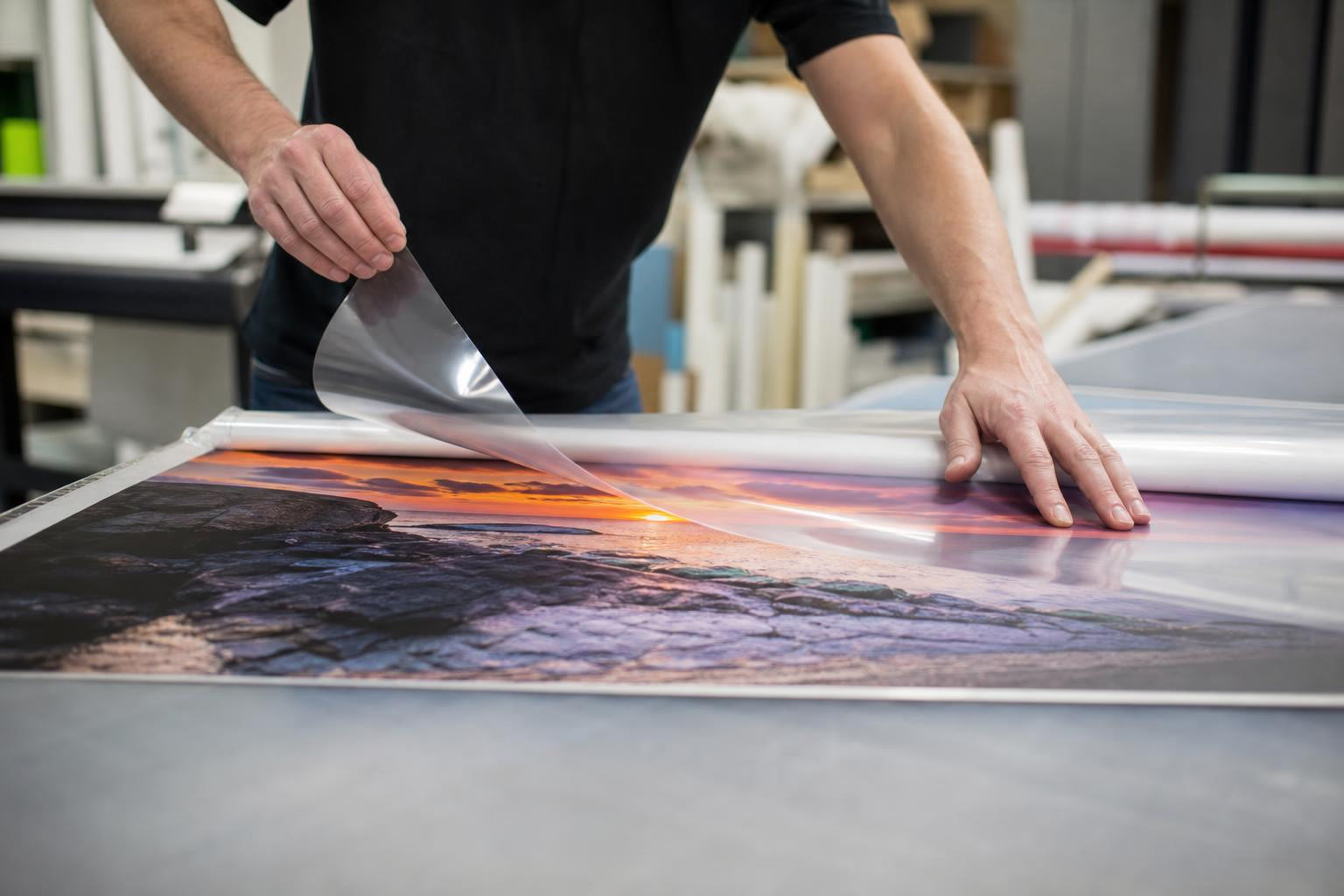
Lamination is the process of bonding a clear plastic film onto a printed surface to make it stronger and more durable. The film protects against stains, tears, moisture, fingerprints, and UV exposure. On most printed materials (brochures, menus, posters), lamination also adds structural rigidity.
On foam board signs, though, the equation is different. The substrate is already rigid. You’re not laminating to prevent curling or add stiffness. Instead, the lamination serves two roles: surface protection (keeping ink from smudging, resisting fingerprints and scuffs) and light control (determining how the sign interacts with ambient and direct lighting).
That distinction matters because it simplifies your decision. You don’t need to worry about mil thickness for structural reasons. You just need to answer two questions: Where will this sign be displayed? And what does it need to do?
A Quick Note on Thickness
Lamination film thickness is measured in mils, where one mil equals one-thousandth of an inch. Thinner films (1.5 mil) suit temporary items like labels and decals. Thicker films (5 to 10 mil) add serious rigidity and protection for items that will see heavy handling or harsh environments. For foam board signs, the board itself provides the structure, so standard lamination thickness works well for most applications.
Matte Lamination
Definition: Matte lamination applies a non-reflective, smooth film with a flat finish. It produces what many describe as a velvety texture that softens the appearance of printed colors slightly while eliminating surface glare.
Why Professionals Prefer Matte for Indoor Signs
If you spend any time in sign-making forums, you’ll notice a clear pattern. Practitioners on Signs101 report that matte dominates indoor work. One experienced professional put it bluntly: “It didn’t take long to discover that Glossy equals Glare. Now 95% of our work gets matte.” Multiple professionals on the same forum converge on a simple rule of thumb: matte for indoor, gloss for outdoor.
The reasons are practical, not aesthetic:
- Glare elimination. Under overhead fluorescent lights, track lighting, or camera flash, matte lamination stays readable. Text doesn’t wash out under direct lighting the way it does with gloss.
- Fingerprint resistance. Matte film resists fingerprints, scuffs, scratches, and dirt better than glossy film. When a sign gets handled at a trade show or passed around a conference table, it stays clean.
- Scratch concealment. Because the surface doesn’t shine, small scratches are nearly invisible. This is a real advantage for signs that get transported or set up repeatedly.
- Readability. The softer finish provides a more natural look that makes text easier to read, especially on text-heavy signs like courtroom exhibit boards or informational displays.
- Writability. Matte lamination allows some pens and pencils to write on it, which can be useful for annotation during presentations.
The Trade-Offs
Matte does soften the contrast of darker colors. If your design relies on deep blacks and saturated hues popping off the board, matte will tone that down slightly. It produces an elegant, sophisticated finish, but “sophisticated” and “eye-catching from 30 feet away” are different goals.
Best Uses for Matte Lamination
- Courtroom exhibits and trial presentation boards (no glare under courtroom lighting)
- Trade show displays, especially hanging foam board signs under convention center lighting
- Event signage and wedding signs that will be photographed (matte tends to photograph better because it avoids the light flare you get with glossy surfaces)
- Office wall-mounted foam board prints in conference rooms
- Any text-heavy sign meant to be read up close
- Step-and-repeat photo backdrops where camera flash would create glare on gloss
For a deeper look at how lamination affects washability and reuse, see choosing lamination for reusable signs.
Gloss Lamination
Definition: Gloss lamination applies a shiny, glass-like film that enhances the color and vibrancy of printed ink. It creates a reflective surface that makes images and graphics appear more vivid and saturated.
When Gloss Is the Right Call
Gloss lamination exists for a reason. It makes colors pop. If your sign is a product photo, a piece of art, or a bright retail display designed to grab attention from across a store, gloss does that job better than matte. The reflective surface intensifies hues and adds depth to images.
Gloss is commonly used for marketing and promotional pieces where visual impact matters more than readability under controlled lighting. It also cleans easily. Dirt, dust, and fingerprints wipe right off, which matters for signs in high-traffic retail environments.
For outdoor applications, practitioners note that gloss will look better longer since the shiny surface sheds grime more effectively than matte.
The Trade-Offs
The main drawback is glare. Under bright lighting, gloss lamination creates reflections that can make text difficult to read. Fingerprints and smudges are also more obvious on gloss, even though they clean off easily. And if your sign will be photographed, every camera flash creates a hot spot on a glossy surface.
Most pens and markers don’t work well on gloss either. Ink won’t stick or will smear easily, so annotation isn’t practical.
Best Uses for Gloss Lamination
- Retail point-of-purchase displays and countertop signs where color vibrancy draws customers in
- Product photography reproductions and art prints, including foam board collages
- Window displays where natural light enhances rather than fights the reflective surface
- Freestanding floor signs in retail environments viewed from a distance
- Any sign where the primary goal is visual impact and the lighting conditions are controlled or favorable
Dry-Erase Lamination
Definition: Dry-erase lamination applies a clear, writable film over printed graphics or blank substrates. It transforms any sign surface into a functional dry-erase board while preserving the visibility of the printed design beneath it.
This is a fundamentally different category from matte and gloss. Matte and gloss are aesthetic choices. Dry-erase is a capability choice. It changes what the sign can do.
Why Dry-Erase Lamination Exists
Standard laminated signs are static. What’s printed is what you get. Dry-erase lamination makes a sign reusable. You can print a permanent branded template (a logo, a border, column headers, a calendar grid) and then write changing information on top with dry-erase markers.
This makes it ideal for custom dry erase boards in offices, restaurants, and schools, as well as oversized foam board checks where the recipient’s name and dollar amount change with each presentation.
Quality dry-erase laminate has a rated life of 6 to 8 years with proper care, according to industry sources. That’s years of daily use from a single sign.
The Trade-Offs (and They’re Significant)
Dry-erase lamination costs more than standard matte or gloss. It’s also more demanding to maintain. Here’s what most consumer-facing content won’t tell you:
Not all markers are equal. Practitioners on signage forums report that even expensive porcelain whiteboards stain with certain marker brands. One sign professional specifically warned against some Expo markers and recommended Quartet or Staedtler brands for cleaner erasure. This isn’t a laminate quality issue; it’s a marker chemistry issue that affects every dry-erase surface.
Ghosting is real. Any dry-erase surface, even high-end whiteboards, will stain if marker is left on too long. One sign maker shared their preventive approach: they apply a quick coat of car wax on top of the print surface and warn customers that leaving marker on for extended periods makes removal more difficult.
Heat sensitivity. Dry-erase film can warp and peel in extreme heat, limiting its use outdoors or in high-temperature areas. For indoor applications, this is rarely an issue.
Best Uses for Dry-Erase Lamination
- Oversized novelty checks for awards and fundraisers
- Restaurant and café daily specials boards
- Office scheduling and meeting room boards
- Healthcare facility information displays
- Warehouse inventory tracking signs
- School and training room displays
- Any sign where the information changes regularly but the branding stays constant
Dry-Erase Care Tips
- Use quality dry-erase markers. Quartet and Staedtler get strong recommendations from professionals.
- Erase writing at the end of each day. Don’t leave marker on the surface for days at a time.
- Clean periodically with a dedicated whiteboard cleaner, not just a dry eraser.
- Consider applying a thin coat of car wax after cleaning to maintain the surface and prevent ghosting.
Luster and Satin: The Professional’s Middle Ground
There’s a lamination type that rarely shows up in consumer-facing content but that professionals reach for constantly. Luster (sometimes called satin) sits between matte and gloss. It gives you some shine without going overboard, reducing harsh reflections without flattening the image as much as full matte.
One Signs101 professional explained their preference: “I commonly use a luster laminate. It’s a happy medium between gloss and matte for our large outdoor advertising and backlit signs. That way it doesn’t look unfinished and has a bit of sheen without glare.”
Luster isn’t available from every printer, and it’s not always an option for foam board signs specifically. But it’s worth knowing about, especially for photo-quality display graphics where some vibrancy is desired without the glare problems of full gloss.
Quick-Decision Table: How to Choose Lamination for Your Sign
| Your Situation | Choose Matte | Choose Gloss | Choose Dry-Erase |
|---|---|---|---|
| Sign will be photographed (events, PR) | ✓ | ||
| Displayed under overhead or artificial lighting | ✓ | ||
| Need vibrant color pop visible from a distance | ✓ | ||
| Sign will be handled frequently | ✓ | ||
| Need to write and update information | ✓ | ||
| Retail shelf, counter, or window display | ✓ | ||
| Courtroom or formal presentation | ✓ | ||
| Office meeting or scheduling board | ✓ | ||
| Oversized novelty check | ✓ | ||
| Art reproduction or photo collage | ✓ | ||
| Trade show booth display | ✓ | ||
| Restaurant daily specials | ✓ |
When in doubt, matte is the safer choice for indoor signs. You can always add visual impact through design (bolder colors, higher contrast) without fighting glare.
The Decision Framework: Environment First, Aesthetics Second
The most common mistake when choosing lamination for printed signs is starting with how you want the sign to look. Start instead with where the sign will live and what it needs to survive.
Step 1: Identify the lighting. Fluorescent overhead lights, track lighting, camera flash? Go matte. Natural window light, controlled gallery spots? Gloss can work.
Step 2: Assess handling frequency. Will people touch this sign, move it, point at it during presentations? Matte resists fingerprints and hides scratches.
Step 3: Determine if the content changes. If any part of the sign needs to be updated regularly, dry-erase is your only option among standard laminations.
Step 4: Consider photography. If the sign will appear in photos (event coverage, social media, press), matte eliminates the hot spots that ruin images.
Step 5: Now consider aesthetics. Only after answering the functional questions should you think about whether you prefer the soft elegance of matte or the vibrant punch of gloss.
In real-world signage use, what lasts longer is mainly determined by the laminate’s quality and UV performance rating, the print system underneath, and the exposure conditions, not simply whether it’s matte or gloss. Both finishes protect equally well when the laminate quality is comparable.
Common Lamination Mistakes to Avoid
1. Choosing gloss for event signage. This is the most frequent error. Every photographer at your event will curse the glare. Every phone photo your guests take of your wedding sign or award presentation will have a white hot spot dead center. Matte eliminates this entirely.
2. Using the wrong markers on dry-erase laminate. Not all dry-erase markers perform the same on laminated surfaces. Cheap markers or certain brands ghost and stain faster. Stick with Quartet or Staedtler, and test before writing on the final sign.
3. Leaving dry-erase marker writing on for weeks. The longer marker sits on a dry-erase surface, the harder it is to remove cleanly. Erase and rewrite daily if possible, weekly at most.
4. Skipping lamination entirely on high-touch signs. Unlaminated prints degrade fast. Fingerprints, scuffs, and moisture damage the ink surface within days of heavy handling. Even for a one-day event, lamination is worth it for signs people will touch.
5. Assuming gloss means “more professional.” Practitioners overwhelmingly report the opposite for indoor use. Matte reads as more polished and intentional in most indoor settings. Gloss can look cheap under the wrong lighting.
Ready to Order?
Once you know which lamination fits your project, the rest is straightforward. You can configure your exact size, material thickness, lamination type, and finishing options at checkout.
Browse custom foam board printing with matte, gloss, or dry-erase lamination. Orders placed by midnight ship the next business day with free UPS Ground shipping.
Need help deciding? Foam Board Print Shop offers manual file review and visual proofing on every order, so you’ll see exactly what your sign looks like before it prints. You can also reach a real person by phone or text at 804-240-4070.
Frequently Asked Questions
What is the best lamination for a sign that will be photographed?
Matte lamination, without question. It eliminates glare from camera flash and ambient lighting, producing clean, even photos. This applies to wedding signs, event backdrops, step-and-repeat banners, and any sign that will appear on social media or in press coverage.
Can you write on matte lamination?
Yes, matte lamination accepts some pens and pencils, making it useful for light annotation during presentations or courtroom work. However, it’s not designed for repeated writing and erasing. If you need a truly writable and erasable surface, choose dry-erase lamination.
How long does dry-erase lamination last?
Industry sources indicate that signage with quality dry-erase laminate has a rated life of 6 to 8 years. Proper care extends that life, including using recommended marker brands, erasing regularly, and cleaning the surface periodically with whiteboard cleaner.
Does gloss or matte lamination last longer?
Durability depends more on laminate quality and UV rating than on the finish type. Both matte and gloss protect the printed surface effectively. The real difference is functional: matte hides wear better because scratches don’t catch light, while gloss shows minor damage more readily but cleans more easily.
Is luster lamination better than matte or gloss?
Luster (or satin) is a middle ground that professionals often prefer for display graphics and backlit signs. It provides some color enhancement without harsh glare. It’s not universally available, though, and for most indoor foam board sign applications, matte or gloss covers the practical needs.
Why does my dry-erase board ghost after a few weeks?
Ghosting happens when dry-erase marker pigment absorbs into the surface over time. The fix is preventive: erase writing daily rather than leaving it for extended periods, use quality markers (Quartet and Staedtler perform better than some Expo products on laminated surfaces), and apply a thin coat of car wax periodically to maintain the surface barrier.
Do I need lamination on foam board signs?
Foam board is already rigid, so lamination isn’t about structural support. But it protects the printed surface from fingerprints, scuffs, moisture, and fading. For any sign that will be handled, displayed for more than a day, or used in a professional setting, lamination is a worthwhile addition. To understand what foam board is and how it performs across different use cases, that background can help inform your material and lamination choices together.
Should I choose matte or gloss for a retail sign?
For retail, it depends on placement. A countertop sign at the register under overhead lights benefits from matte. A window display sign where sunlight hits it from behind benefits from gloss. A floor-standing sign viewed from across the store benefits from gloss’s color vibrancy. When in doubt for retail, gloss tends to win because the primary goal is grabbing attention from a distance.


