

TL;DR
What is foam board? It is a lightweight rigid sheet made from a foam center sandwiched between two smooth outer layers. It is used for indoor signs, displays, presentations, mounted photos, event signage, trade show graphics, architectural models, and school exhibitions. Standard foam board works best in dry indoor settings and is not suited for long term outdoor use. Common thicknesses are 3/16" and 1/2", and popular sizes range from 12" x 18" up to 48" x 96". PVC foam board is a related but distinct material made entirely of foamed plastic, offering better moisture resistance.
Quick Answer: What Is Foam Board?
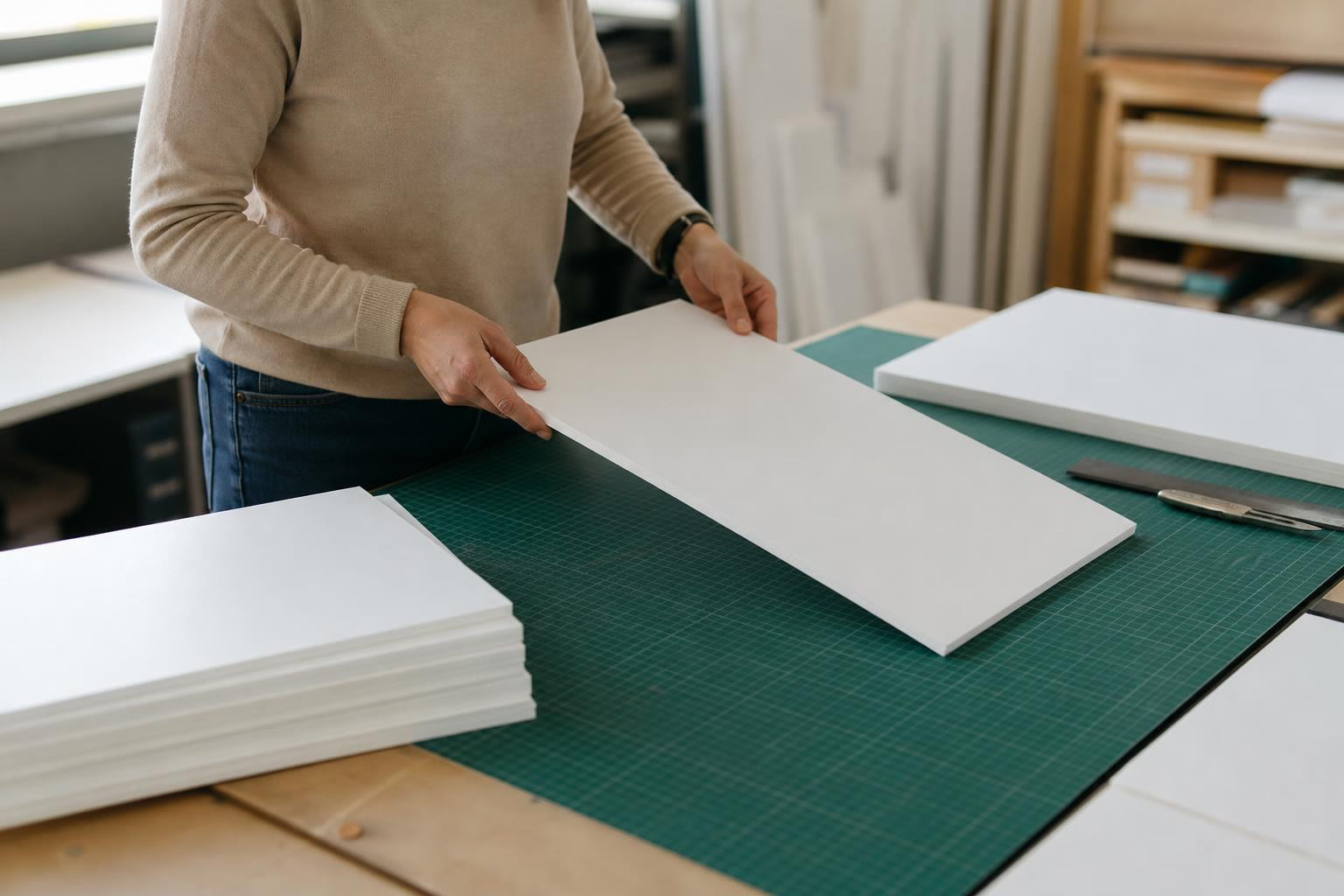
Foam board, also called foam core board, is a three layer display material. A foam center (usually polystyrene) sits between two smooth outer facing layers, typically paper or plastic. The result is a sheet that is rigid enough to stand flat on an easel but light enough to carry with one hand.
Curbell Plastics defines it as a rigid, lightweight graphic art board with a foam core between two outer layers that can be printed, painted, mounted, laminated, die cut, and knife cut.
Think of it as a sandwich: printable face on top, foam in the middle, printable face on the bottom.
If you already know foam board is right for your project, you can order custom foam board prints in multiple thicknesses with optional lamination and finishing.
One important note: in construction, "foam board" often refers to rigid insulation panels made from polyisocyanurate or polyurethane. This article covers graphic and display foam board, the kind used for signs, presentations, and printed displays.
What Is Foam Board Made Of?
The composition is straightforward. The core is typically extruded polystyrene foam, which gives the board its thickness and stiffness without adding much weight. The outer facers create a smooth, printable surface.
Facer materials vary depending on the product grade:
- Clay coated paper is the most common, giving a bright white printable surface
- Kraft paper is used on economy grades
- Archival or acid free paper is used for museum and conservation mounting
- Wood fiber veneer is used on premium boards like Gatorfoam for added durability
- Plastic or poly coated facers appear on moisture resistant grades
Curbell Plastics describes the well known FOME COR brand as extruded polystyrene foam with clay coated paper facers, with specialty versions including canvas textured facers, acid free facers, and self adhesive options.
One thing to know: the foam core is visible at the edges. On white foam board, this looks clean. On black foam board, the dark edge creates a more finished appearance for gallery or event displays.
Foam Board vs. PVC Foam Board: What Is the Difference?
People often search for "what is foam board" and land on two very different products. Standard foam core board and PVC foam board share a name but differ in structure, durability, and best use cases.
Standard foam board is the polystyrene core with paper or plastic facers described above. It is lightweight, affordable, and designed for short to medium term indoor display.
PVC foam board (sometimes sold under brands like Sintra, Komatex, or Celtec) is a solid sheet of foamed polyvinyl chloride with no separate core or facer layers. It is denser, heavier, and inherently moisture resistant. PVC foam board will not delaminate because there are no layers to separate.
| Feature | Standard Foam Board | PVC Foam Board |
|---|---|---|
| Core material | Polystyrene foam | Foamed PVC plastic |
| Facers | Paper, plastic, or veneer | None (solid sheet) |
| Water resistance | Poor (paper facers absorb moisture) | Good (plastic is inherently waterproof) |
| Weight | Very light | Moderate |
| Dent resistance | Low | High |
| Cost | Low | Higher |
| Best for | Short term indoor signs, events, presentations | Longer term signs, damp environments, repeated handling |
If your project involves bathrooms, kitchens, covered outdoor areas, or any environment with humidity, PVC foam board is the safer choice. For a one day conference, a wedding reception, or a classroom presentation, standard foam core is more than adequate and much cheaper.
Foam Board Print Shop offers a 3 mm waterproof board option for situations where standard foam core would not hold up.
Is Foam Board the Same as Foam Core?
In everyday printing and signage language, yes. The terms are used interchangeably. GotPrint explicitly states that foam board and foam core board refer to the same product, with "foam core" technically pointing to the polystyrene center layer.
You will see both terms used by print shops, craft stores, and suppliers. "Foam board" tends to appear more in signage contexts. "Foam core" is slightly more common in framing and mounting discussions. But they describe the same three layer material.
What Is Foam Board Used For?
Foam board shows up in more places than most people realize. Its combination of flat rigidity, light weight, and clean print surface makes it useful across a wide range of applications:
- Indoor signs for retail, offices, lobbies, and restaurants
- Event signage including welcome signs, seating charts, and directional signs
- Trade show graphics and booth displays
- Presentation boards for meetings, pitches, and classrooms
- Retail displays and point of purchase signage
- Mounted posters and photo displays
- Menu boards for cafes, bars, and catering events
- Courtroom exhibits and meeting visuals
- Big checks for fundraisers, awards, and promotions
- Cutouts and standees for parties, sports events, and marketing
- Architectural models for design studios and client presentations
- School exhibition displays for science fairs, art shows, and project showcases
- Portable signage for pop up shops, farmers markets, and mobile promotions
Curbell lists uses including POP displays, exhibits, kiosks, framing, mounting, short term interior signage, and props. If you need event ready cutouts, you can order foam board standees and cutouts or big foam board checks for presentations and ceremonies.
Practitioners on Reddit report that foam board is a go to for wedding and event signage. One user in a wedding planning thread said the print quality was "perfectly fine" for their event, though they cautioned that outdoor placement risks the sign blowing away unless it is fastened or weighted.
Foam Board for Architectural Models
Architecture students and design professionals have used foam board for model making for decades. The material cuts cleanly with a sharp blade, bonds easily with white glue or hot glue, and comes in white or black to match presentation aesthetics.
Foam board works especially well for massing models (where the goal is to show building volume and spatial relationships rather than fine detail). A 3/16" sheet can represent walls, while layered pieces create floors and rooflines. The lightweight core means even large models stay portable for studio critiques and client meetings.
Practitioners on Reddit's architecture forums note that foam core is their default for quick study models because it is cheap enough to iterate without hesitation. When precision matters more, they switch to museum board or basswood, but foam core remains the workhorse for early design exploration.
For printed presentation boards that accompany architectural models at reviews, a custom foam board print with site plans, renderings, and diagrams mounted on foam core creates a cohesive display.
Foam Board for School Exhibition Displays
Science fairs, history projects, art shows, and classroom exhibitions are where many people first encounter foam board. It is the material behind the classic trifold presentation board, and it works equally well as flat panels mounted to walls or propped on tables.
Teachers and parents prefer foam board for student displays because it is stiff enough to stand on its own, accepts glue, tape, and pushpins without collapsing, and costs little enough to use for a single event. A 24" x 36" printed panel on foam core can hold charts, photos, and text in a layout that looks far more polished than a hand decorated poster board.
For school exhibitions that involve multiple boards, countertop foam board prints with built in feet make setup simple without needing easels or wall space.
Foam Board for Portable Signage
The combination of stiffness and near zero weight makes foam board a natural fit for portable signage. Pop up shops, farmers market vendors, real estate open houses, and mobile food businesses all use foam board signs that can be carried in one hand and set up in seconds.
A 18" x 24" foam board sign fits in the back seat of a car. A 24" x 36" board slides into a trunk. Neither requires special transport equipment.
The tradeoff is durability. A sign that travels to a new location every weekend will take more hits than one placed once in a lobby. Adding lamination (matte or gloss) protects the print surface from fingerprints and minor scuffs. Using 1/2" thickness instead of 3/16" adds rigidity that resists flexing during transport.
For vendors who need signs they can grab and go, pairing a foam board print with foam board triangle feet creates an instant freestanding display that packs flat.
Why Use Foam Board? The Main Advantages
Now that we have covered what is foam board and where it is used, here is why it remains so popular. Foam board solves a specific problem: making a display look professional without making it heavy, expensive, or hard to install.
It stays flat. Unlike poster board or paper, foam board holds its shape on an easel, wall, or counter. A 24" x 36" foam board sign will not curl at the edges the way a paper poster does.
It is genuinely light. A standard 3/16" foam board panel weighs very little, which makes it easy to carry to events, hang from ceilings, ship across the country, and swap out when promotions change.
It prints cleanly. The smooth facer surface accepts direct UV printing, screen printing, mounted graphics, and paint. This is why print shops use it as a go to substrate for short run indoor signage.
It is affordable. Compared to acrylic, PVC, aluminum composite, or wood, foam board costs significantly less. For a one day event, a weekly retail promotion, or a conference booth, the price to appearance ratio is hard to beat.
It is easy to customize. Foam board can be cut to custom shapes, drilled for grommets, rounded at the corners, laminated for protection, and printed on both sides. This flexibility is part of why sign shops and event planners rely on it.
What Are the Downsides of Foam Board?
Honesty matters here. Foam board is not a rugged material, and pretending otherwise leads to bad project decisions.
It dents. Even a soft impact can leave a visible mark. Printleaf's handling guide warns that foam core boards are delicate and can show damage from minor hits.
Standard grades are indoor only. Curbell lists standard foam board grades as not suitable for outdoor use. Rain, sun, wind, and humidity all pose problems.
It can warp. Good Guys Signs warns that larger foam board signs can begin to warp after about 60 days, especially in humid environments.
Corners crush easily. This is the most common complaint among printers and buyers. Edges and corners are vulnerable during handling and shipping, which is why packaging quality matters as much as print quality (more on this below).
These limitations do not make foam board a bad choice. They make it a specific choice. It excels indoors, for short to medium display periods, in controlled environments. Match it to that context and it performs well.
Foam Board vs. Other Display Materials
Understanding what is foam board also means understanding what it is not. Here is how it compares to materials people commonly confuse it with.
| Material | Structure | Best For | Main Limitation |
|---|---|---|---|
| Poster board | Single layer of thick paper/cardstock | Quick paper signs, school projects | Bends and curls easily |
| Foam board | Foam core between two smooth facers | Indoor signs, events, displays, presentations | Dents, warps with moisture |
| PVC foam board | Solid or foamed plastic sheet | Damp areas, longer term signs | Heavier, more expensive |
| Gatorboard | Foam core with wood fiber veneer facers | Longer lasting indoor displays, repeated handling | Higher cost |
| Coroplast | Corrugated plastic | Yard signs, temporary outdoor signs | Fluted surface, less polished look |
Frame Destination explains that poster board is a single dense paper layer while foam board is a three layer composite with a foam center, making foam board significantly more rigid.
On Signs101, sign professionals regularly distinguish standard foam core from Gatorfoam. The consensus in one thread is that foamcore works for short term or one day signs, while Gatorfoam is preferred for signs that need to survive longer because it resists denting and warping better. The tradeoff is clear: foam core is much cheaper, but it is less forgiving.
A LinkedIn post from a sign supply company echoed this, noting that standard foam core can bow or crush under pressure, while premium rigid boards offer cleaner edges and more consistent results for shops that need reliable installation.
The Foam Board Fit Test: 4 Questions to Ask
Before ordering, run through these four questions. They will tell you whether foam board is the right material or whether you should look elsewhere.
1. Where will it live?
If the board stays indoors in a dry, climate controlled space, foam board is a strong fit. If it will face rain, humidity, direct sun, or wind, standard foam board is risky.
2. How long does it need to last?
One day to a few weeks: foam board is usually ideal. Months of display: consider thicker foam board with lamination, or step up to Gatorboard or PVC. Permanent signage: use metal, acrylic, or aluminum composite. For guidance on protective coatings, see this guide on choosing lamination for reusable signs.
3. How much handling will it get?
Placed once on an easel or wall and left alone? Foam board is fine. Moved daily, shipped repeatedly, or handled by crowds? Add lamination, upgrade thickness, or choose a stronger substrate.
4. How will it be displayed?
The display method affects the spec. A hanging double sided sign may need grommets. A countertop sign needs feet. A window sign needs suction cups. A wall display needs clips or standoffs.
If your sign will hang from the ceiling or an aisle fixture, hanging foam board prints with grommets and hardware solve that problem. For wall displays, wall mounted foam board prints come with matching clips or standoffs.
Common Foam Board Thicknesses
Thickness is one of the first decisions after choosing foam board. Here is what to know.
3/16" (approximately 5 mm) is the standard thickness for most indoor signs and displays. It is the default at most print shops and works well for signs up to about 24" x 36" that will sit on an easel, hang on a wall, or stand on a counter.
1/2" (approximately 13 mm) adds more body and rigidity. It is better suited for larger signs, freestanding displays, or situations where the board needs to feel more substantial. Both Square Signs and GotPrint position 1/2" foam board as the choice for larger or more durable applications.
1/8" (approximately 3 mm) is thinner and lighter, useful for smaller signs, lightweight displays, or situations where the board will be mounted in a frame or holder that provides its own structure.
Thicker does not always mean better. A 3/16" board on a solid easel can look just as professional as a 1/2" board. Consider your display method, sign size, and handling expectations before defaulting to the thickest option.
Common Foam Board Sizes
Foam board comes in a range of standard sizes. The most popular for printed signs and displays include:
- 12" x 18" for tabletop signs, small directional signs, and counter displays
- 18" x 24" for retail announcements, event signs, and booth graphics
- 24" x 36" for welcome signs, seating charts, presentation boards, and trade show displays
- 36" x 48" for larger retail graphics and conference visuals
- 48" x 96" for full panel production and oversized displays
Square Signs identifies 12" x 18", 18" x 24", and 24" x 36" as the most relied on rectangular dimensions for printed foam board. Custom sizes are common in professional printing. Many shops can cut to any dimension within their maximum sheet size.
Can Foam Board Be Printed On?
Yes, and this is where foam board moves from craft supply to commercial display material.
Direct printing is the most common professional method. A UV flatbed printer applies ink directly onto the foam board surface. This produces sharp, vibrant graphics without a separate mounting step.
Mounted graphics are the other approach. A poster or vinyl graphic is printed separately and then adhered to the foam board surface. This method is still used but has been largely replaced by direct printing for most sign applications.
Foam board also accepts paint, markers, lamination, and screen printing.
A common anxiety among first time buyers is file setup. Practitioners on Reddit report confusion about DPI, CMYK color mode, bleed areas, and edge to edge printing. A former print shop employee in a ProCreate thread advised creating artwork at the final print size, using high resolution files (300 DPI for photos), converting to CMYK if possible, and requesting a proof before production. For a deeper walkthrough, this guide on how to prepare high DPI files covers the essentials.
Is Foam Board Waterproof?
No, standard paper faced foam board is not waterproof. The paper facers absorb moisture, and the foam core can degrade when wet. Curbell Plastics notes that standard grades are not suitable for outdoor use and that only certain specialty grades offer water resistance.
For a brief outdoor event (a wedding ceremony, a farmers market, a same day promotion), foam board can work if you secure it against wind and keep it dry. But it should not be treated as outdoor signage.
Wedding planners on Reddit consistently raise this concern. One user asking about a 24" x 36" outdoor welcome sign was advised that foam board is too light to resist wind and should be secured to the easel with Velcro or tape.
If your project involves moisture, humidity, or any outdoor exposure, a waterproof board, PVC, or coroplast is a safer pick.
How to Display Foam Board
Foam board is versatile in how it can be shown, which is part of its appeal.
On an easel. The classic choice for events, weddings, conferences, and presentations. Metal or wooden easels support the board upright at eye level. You can order a metal easel with foam board prints as a complete kit.
On a counter or table. Triangle feet, L feet, or adhesive upright holders turn a flat board into a freestanding tabletop sign. For this setup, countertop foam board prints come ready with matching hardware.
On a wall. Foam board wall clips, standoffs, drilled holes, or adhesive strips let you mount boards in lobbies, offices, retail spaces, and hallways. Foam board wall clips snap onto the board edges for a clean, tool free installation.
In a window. Suction cups with clips or hooks attach the board to glass, making it visible from outside for storefront promotions and restaurant specials.
From the ceiling. Drilled holes or grommets paired with hooks, strings, or ceiling clips allow the board to hang in aisles, above booths, or from drop ceilings. Double sided printing is common here so the sign reads from both directions.
Freestanding on the floor. A floor sign holder or weighted base supports the board upright in lobbies, retail aisles, or event spaces.
The display method should be decided before ordering, because it affects whether you need grommets, drilled holes, rounded corners, double sided printing, or specific hardware.
How to Store and Handle Foam Board
Foam board is easy to damage if you are not paying attention. A few simple habits prevent most problems.
Store flat. Leaning boards against a wall for extended periods can cause bowing. Lay them flat on a clean surface, or store them vertically in a rack designed for rigid sheets.
Keep it dry. Moisture is the enemy of paper faced foam board. Store in a cool, dry, indoor space away from humidifiers, open windows, or leaky pipes.
Protect corners and edges. Corners are the most vulnerable part. Use corner protectors during transport and avoid bumping edges against door frames, car trunks, or other hard surfaces.
Handle with clean hands. Fingerprints, oils, and dirt can mark the surface, especially on unlaminated boards. Lamination (matte or gloss) adds a protective layer that resists smudges and minor scuffs.
Do not stack heavy items on top. The foam core compresses under sustained pressure, leaving permanent dents.
Why Shipping and Packaging Matter
This is the part most articles skip, and it is the part that causes the most real world frustration.
Foam board is lightweight but fragile. Practitioners on the CommercialPrinting subreddit report that packing a single rigid board can take longer than actually printing it, and that corner damage is the most common shipping failure. Boards get dropped, tossed on conveyor belts, or crushed by heavier packages in transit.
Good packaging means rigid boxes, corner protection, edge padding, and enough cushioning to absorb impacts. Several commenters in that thread recommended pricing packaging as part of the product, not treating it as an afterthought.
This is worth considering when choosing a printer. A shop that prints beautifully but ships carelessly will deliver a damaged board. A printer that understands foam board shipping at scale, with proper boxing and corner protection, delivers the actual result you are paying for. For details on typical delivery windows, see how long free UPS Ground takes.
Foam Board Print Shop includes specialized packaging for fragile foam core and offers free UPS Ground on all orders in the contiguous U.S. Orders placed by midnight ship the next business day.
Preparing Artwork for Foam Board Printing
If you are designing your own file for a foam board print, a few basics will save you time and avoid reprints.
Design at final size. If you want a 24" x 36" sign, set your canvas to 24" x 36". Do not design small and expect the printer to scale up without quality loss.
Use high resolution. 300 DPI is standard for photographic content. For large signs viewed from a distance, 150 DPI can work, but check with your printer.
Include bleed. If your design goes to the edge of the board, extend it 0.125" to 0.25" beyond the trim line. This prevents thin white edges. A step by step walkthrough is available in this guide on how to set bleed for large format prints.
Convert to CMYK. RGB colors on screen do not always translate to print. Converting to CMYK before submission gives you a more accurate preview.
Request a proof. Most professional printers offer a digital proof before printing. Review it carefully, especially for color, text placement, and edge alignment.
Foam Board Print Shop includes manual file review and image proofing with every order, which catches common issues before they reach the printer.
Get a custom foam board print with file review, proofing, and next business day production included.
Frequently Asked Questions
What is foam board?
Foam board is a lightweight rigid board made from a foam core between two smooth outer layers. It is commonly used for indoor signs, displays, presentations, mounted posters, photo backing, cutouts, architectural models, and school exhibitions. Anyone asking "what is foam board" should know it is designed primarily for indoor, short to medium term display purposes.
Is foam board the same as foam core?
In printing and signage, yes. The terms are used interchangeably. "Foam core" technically refers to the polystyrene center, while "foam board" refers to the complete three layer sheet.
What is PVC foam board?
PVC foam board is a solid sheet of foamed polyvinyl chloride plastic. Unlike standard foam core (which has paper facers over polystyrene), PVC foam board is a single material with no layers to delaminate. It is heavier, more durable, and inherently moisture resistant, making it better for damp environments or longer term use.
Is foam board waterproof?
Standard paper faced foam board is not waterproof. It is designed for indoor use. Some specialty grades and alternative boards (like PVC or waterproof board) offer moisture resistance, but standard foam board should not be exposed to rain or sustained humidity.
What thickness of foam board should I use?
The most common thicknesses for printed signs are 3/16" (5 mm) and 1/2" (13 mm). Use 3/16" for standard indoor signs and displays. Use 1/2" for larger signs, portable signage that gets moved frequently, or when you want more rigidity and a more substantial feel.
Can you print directly on foam board?
Yes. Direct UV printing onto foam board is the standard method for professional sign production. Foam board can also accept mounted graphics, screen printing, paint, and lamination.
Does foam board bend or warp?
It can. Foam board is rigid but not indestructible. It may dent from impact, warp in humid conditions, or bow if stored improperly. Lamination and proper storage help extend its useful life.
What is the difference between foam board and Gatorboard?
Standard foam board uses paper facers over a polystyrene core. Gatorboard uses wood fiber veneer facers, making it significantly more rigid and resistant to denting. Gatorboard costs more but holds up better under repeated handling and longer display periods. Knowing what is foam board versus Gatorboard helps you pick the right material for your timeline and budget.
Can foam board be used for architectural models?
Yes. Foam board is widely used for architectural massing models and study models. It cuts cleanly, glues easily, and is cheap enough to allow rapid iteration. For final presentation models requiring finer detail, many architects switch to museum board or basswood.
Can foam board be used outside?
Only for very short, protected situations. Even then, secure it against wind and keep it away from rain. For true outdoor signage, use a weather resistant material like PVC, coroplast, or aluminum composite.


