

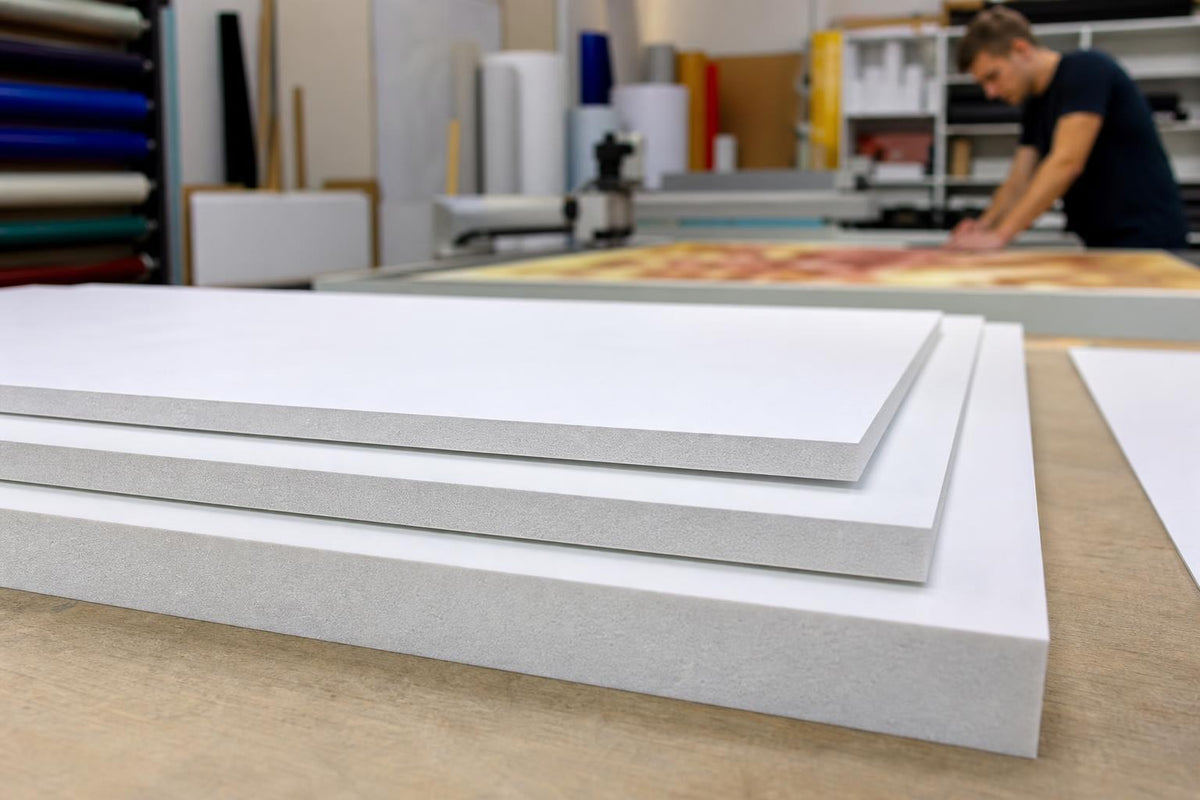
TL;DR
Foam board comes in three standard thicknesses: 1/8", 3/16", and 1/2". For most signs up to 24x36", 3/16" is the industry standard and the safest pick. Go thinner (1/8") only for small, lightweight displays like matted artwork. Go thicker (1/2") for large-format panels, freestanding signs, and anything that needs to stay flat for weeks or months. Your sign’s size, display duration, mounting method, and environment should drive the decision.
Picking foam board thickness sounds simple until you realize the wrong choice means a warped, floppy sign at your trade show booth or a dented welcome board at your client’s event. Most printing guides treat thickness as a footnote, one bullet buried in a long specs page. That’s a mistake. Thickness is the single biggest factor in whether your foam board sign performs or disappoints.
This guide walks through each option, maps it to specific commercial use cases, and gives you a straightforward framework so you can choose the right foam board thickness for a sign with confidence.
Order custom foam board prints in 1/8", 3/16", or 1/2" thickness with next-business-day production.
The Three Standard Foam Board Thicknesses
Foam board (also called foam core) is manufactured in three widely available thicknesses. Each serves a different purpose:
| Thickness | Metric | Approx. Weight | Rigidity | Best For |
|---|---|---|---|---|
| 1/8" | 3 mm | ~0.15 lbs/ft² | Low | Small prints, matted artwork, lightweight hanging signs |
| 3/16" | 5 mm | ~0.25 lbs/ft² | Moderate | Most event signage, retail promos, presentations, courtroom exhibits |
| 1/2" | 13 mm | ~1.07 lbs/ft² | High | Large-format displays, freestanding signs, trade show backdrops, cutouts |
Weight data comes from Square Signs’ thickness comparison, and these numbers matter more than you might think. A 24x36" sign at 0.15 lbs/ft² is easy to hang with a couple of clips. That same sign at 1.07 lbs/ft² needs sturdier mounting.
Beyond these three, some printers also offer a 3 mm waterproof board, which is a separate material from standard foam core. It fills a niche for moisture-prone indoor environments like restaurant kitchens or brewery tasting rooms where traditional foam would deteriorate. You can read more about waterproof board for menus to see if that option fits your situation.
1/8" Foam Board: When Thin Works
One-eighth inch is the thinnest standard foam board, and it exists for a narrow set of purposes. It works well for small photo prints, matted artwork at art shows, and lightweight displays where the board will be framed or mounted flush against a wall.
Photographers who sell matted artwork at art shows often prefer 1/8" because the boards stack compactly and take up less space in transport. When a picture frame provides the structural support, the board itself doesn’t need much rigidity.
Limitations
This is where honesty matters. At 1/8", foam board warps easily, dents under light pressure, and cannot stand on its own. Photography forum members on Photrio consistently recommend stepping up to 3/16" for any unframed use because 1/8" boards bow noticeably over time, even in controlled indoor environments.
When to use 1/8"
- Signs no larger than about 16x20"
- Prints that will be framed or matted
- Lightweight hanging foam board displays where weight needs to stay minimal
- Temporary use measured in hours, not days
If your sign needs to stand upright on a table or last through a multi-day event, skip this thickness.
3/16" Foam Board: The Industry Standard
Three-sixteenths of an inch is the default thickness for foam core, and for good reason. It balances rigidity, weight, and cost in a way that works for the widest range of applications. According to multiple printing industry sources, 3/16" is the most popular foam board thickness sold.
It provides enough stiffness to sit on an easel, lean against a wall, or hang from a ceiling without sagging. For signs up to roughly 24x36", 3/16" handles the job well.
Best use cases for 3/16"
- Retail promotions: Point-of-purchase displays, sale announcements, and seasonal signage
- Event welcome signs: Wedding boards, conference registration signs, sponsor recognition displays
- Courtroom exhibits: Presentation boards for trial graphics (pair with matte lamination for glare control)
- Tabletop and countertop signs: Menu specials, checkout promos, registration desk info
- Presentations: Board-room visuals, school project displays, real estate open house signs
For tabletop applications specifically, countertop foam board prints come with built-in easel backs designed to work with 3/16" stock, so you get a display-ready sign without buying separate hardware.
The warp factor
Here’s what most guides won’t tell you: even at 3/16", foam board can warp over time. Practitioners on the Signs101 professional signmaking forum report that warping is their number-one complaint with foam core. One sign maker on that forum stopped buying foam board altogether, switching to ultraboard with styrene faces because of chronic warping issues.
The practical takeaway is that 3/16" works great for displays lasting days to a few weeks in humidity-controlled spaces. For longer display periods, either step up to 1/2" or add lamination, which stiffens the board and slows moisture absorption. More on choosing a lamination finish is available in a separate guide.
1/2" Foam Board: When You Need It Flat and Stiff
Half-inch foam board is the heavy hitter. It’s substantially more rigid than 3/16", resists bowing across wide spans, and holds up to weeks or months of display time with careful handling.
The math is straightforward: once your sign gets large, toward 36x48" and beyond, thinner boards can’t hold themselves flat under their own weight. At those dimensions, you need the structural backbone that 1/2" provides.
Best use cases for 1/2"
- Trade show backdrops and booth graphics: Large panels that need to stay flat in a convention hall for multiple days
- Freestanding signs: Lobby displays, directional signage, and promotional signs that stand on their own with feet or base hardware
- Life-size standees and cutouts: Big head cutouts and full-body standees need 1/2" to maintain their shape
- Large retail displays: Wall-size promotional graphics, window backdrops, seasonal installations
- Long-duration indoor signage: Any sign that will be displayed for weeks to months
One practical note: 1/2" foam board sheets are available up to 96" long by 48" wide, while 3/16" sheets can go up to 120" by 60". For very large formats, your thickness choice may actually constrain your maximum dimensions.
Still not indestructible
Even at 1/2", foam board remains a lightweight material. It dents if struck with a hard object, and it’s not suitable for outdoor use in rain or direct sun. But for indoor commercial signage that needs to look professional over an extended period, it’s the right call.
How to Choose the Right Foam Board Thickness: Five Decision Factors
Rather than guessing, work through these five factors in order. By the end, the right thickness will be obvious.
Factor 1: Sign Size
This is the most objective factor. Bigger signs need thicker boards.
- Up to 16x20": 1/8" works if framed or supported; 3/16" is safer
- 18x24" to 24x36": 3/16" is the sweet spot
- 36x48" and larger: 1/2" is strongly recommended
A guide on foam core stability by thickness covers the physics of why larger panels need more structure.
Factor 2: Display Duration
How long will the sign be up?
- A few hours (party, one-day sale): 1/8" or 3/16"
- A few days (trade show, weekend event): 3/16"
- Weeks to months (lobby display, ongoing retail promo): 1/2"
The longer a foam board sign is displayed, the more time humidity has to work on it. Forum users across multiple communities, from professional sign shops to hobbyist groups, consistently report that warping accelerates with time. Choosing a thicker board gives you more margin before visible bowing occurs.
Factor 3: Mounting Method
How you plan to display the sign has a direct effect on which thickness you need.
- Wall-mounted flat: The wall provides support, so 3/16" usually suffices even for larger sizes
- Easel display: 3/16" for standard sizes; 1/2" for anything over 30x40"
- Freestanding with feet: 1/2" is typically required because the board carries its own weight
- Hanging from ceiling/overhead: Lighter is better, so 3/16" or even 1/8" for small pieces
- Window display: 3/16" with suction cup hardware for most retail window sizes
Factor 4: Environment
Foam board is an indoor material. Period. If you need outdoor signage, corrugated plastic (Coroplast) is the right choice, as noted by FASTSIGNS.
Within indoor environments, humidity is the variable that matters most. A Photrio forum member explained it plainly: foam board warping is caused by changes in humidity, so any sign in a non-climate-controlled space (warehouse, garage, covered patio) should use 1/2" as a minimum, and even then, expect a limited display life.
Foam board can work at outdoor events as long as it stays in a covered or sheltered area, under a tent, on a covered porch, or inside a gazebo. Direct rain will destroy it.
Factor 5: Lamination
Adding lamination to your foam board print does more than protect the image surface. It adds a thin layer of rigidity and creates a moisture barrier that slows warping.
- Matte lamination: Reduces glare, ideal for courtroom exhibits and conference presentations
- Gloss lamination: Makes colors pop, great for retail displays and photo prints
- Dry-erase lamination: Turns the board into a reusable surface for events and meetings
A laminated 3/16" board will outperform an unlaminated one in both durability and warp resistance. For signs that need to last more than a few days, lamination is cheap insurance. See a breakdown of matte vs. gloss lamination to decide which finish fits your application.
How Thickness Affects Your Display Hardware
This is a detail that almost no guide covers, and it trips up first-time buyers regularly. The hardware you use to display your foam board sign must match its thickness.
Feet and bases
Triangle feet and L-feet have slots cut to specific widths. A foot designed for 3/16" board won’t grip a 1/2" panel, and a foot designed for 1/2" will leave a 3/16" board loose and wobbly. Always check slot width compatibility before ordering hardware.
Wall clips and standoffs
Wall clips grip the board edge, so thickness determines whether the clip holds securely. Standoff hardware creates a floating, dimensional look on the wall but requires drilled holes through the board. Thicker boards handle drilling better without cracking or compressing the foam core.
Grommets
If you plan to hang a sign with grommets, thicker boards hold grommets more securely. A grommet in 1/8" board has very little material to grip and can tear out under tension. At 3/16" and above, grommets are much more reliable. A detailed look at grommet sizing and placement covers what to expect.
The bottom line on hardware
Decide on your thickness first, then pick compatible hardware. Or, order a freestanding foam board print as a kit where the board and display hardware are already matched.
When Foam Board Thickness Isn’t Enough: Alternatives
Sometimes, no foam board thickness will meet your requirements. It’s worth knowing when to step up to a different material entirely.
Gator board is the most common upgrade. It uses a dense, wood-fiber core with rigid outer faces, making it dramatically stiffer than any foam board thickness. According to Printkeg’s comparison, gator board costs roughly 2 to 3 times more but can last two years or more with proper care. For multi-event reuse, repeat trade show exhibitors, or permanent installations, the extra cost often pays for itself.
Hobby and professional communities confirm this tradeoff. Users on the MRH Model Railroad Forum note that gator board is the better option when foam board warping becomes unacceptable, though the price difference stings. A detailed comparison of foam board vs. gator board can help you decide where that line falls for your budget and use case.
For moisture-prone indoor areas (think restaurant host stands, brewery menus, spa reception desks), a 3 mm waterproof board provides durability that standard foam core can’t match, without jumping to the higher price point of gator board.
Quick-Pick Thickness Reference by Sign Type
| Sign Type | Recommended Thickness | Why |
|---|---|---|
| Wedding welcome sign (24x36") | 3/16" | One-day use, easel-mounted, climate-controlled venue |
| Trade show booth panel (48x72") | 1/2" | Large format, multi-day display, needs to stay flat |
| Restaurant menu board (11x17") | 3/16" or 3 mm waterproof | Small size, but consider moisture exposure |
| Courtroom exhibit board (30x40") | 3/16" with matte lamination | Moderate size, handled carefully, glare reduction needed |
| Retail sale announcement (18x24") | 3/16" | Standard size, short-term promo, easel or wall-mounted |
| Lobby directional sign (24x36", months of use) | 1/2" | Extended display, needs warp resistance |
| Life-size standee or cutout | 1/2" | Must be freestanding and self-supporting |
| Hanging aisle sign (12x18", double-sided) | 3/16" or 1/8" | Small, lightweight, supported by hanging hardware |
| Big head cutout for events | 1/2" | Handheld, needs rigidity to maintain shape |
| Conference presentation board (36x48") | 1/2" | At the size threshold, longer display, professional setting |
Frequently Asked Questions
What is the most common foam board thickness for signs?
3/16" (5 mm) is the industry standard. It accounts for the majority of foam board sign orders and works well for most indoor applications up to about 24x36".
Can I use 3/16" foam board for a large sign like 48x72"?
You can, but you probably shouldn’t. At that size, 3/16" will bow and flex noticeably, especially if it’s freestanding or displayed for more than a few hours. Step up to 1/2" for anything 36x48" or larger.
Does foam board thickness affect shipping cost?
Thicker boards weigh more and require more protective packaging. However, Foam Board Print Shop includes free UPS Ground shipping on all orders to the contiguous U.S., so thickness won’t change your shipping cost.
Will lamination prevent my foam board sign from warping?
Lamination slows warping by adding a moisture barrier, but it won’t prevent it entirely if the sign is displayed for months in a humid environment. Combining a thicker board with lamination gives you the best warp resistance.
Is 1/2" foam board durable enough for a trade show?
For a single trade show lasting a few days, 1/2" foam board handles the job well with careful handling. If you plan to reuse the same graphics across multiple shows over months, gator board is the more durable option.
Can foam board signs be used outdoors?
Only in sheltered, covered areas like tents, porches, or gazebos. Direct rain and prolonged sun exposure will damage foam board regardless of thickness. For true outdoor use, corrugated plastic or aluminum composite are better materials.
How do I know which display hardware fits my foam board thickness?
Hardware like triangle feet, wall clips, and L-feet are manufactured with specific slot widths. Check the product specs to confirm compatibility with your chosen thickness (1/8", 3/16", or 1/2") before ordering.
Ready to order? Upload your artwork and select your thickness at checkout. Every file gets a manual review and visual proof before printing, so you can confirm everything looks right before production begins.


