

TL;DR
Foam board grommets are two-piece metal rings (a grommet and a washer) that reinforce holes in foam core boards for hanging. Standard banner grommets will crush foam board, so you need long-neck or XL grommets with a longer barrel to fit the board’s thickness without damage. Most print shops use #2 (⅜") grommets placed about 0.75 inches from each corner. If you want to skip the DIY headaches, order your foam board prints with grommets pre-installed as a finishing option.
What Is a Foam Board Grommet?
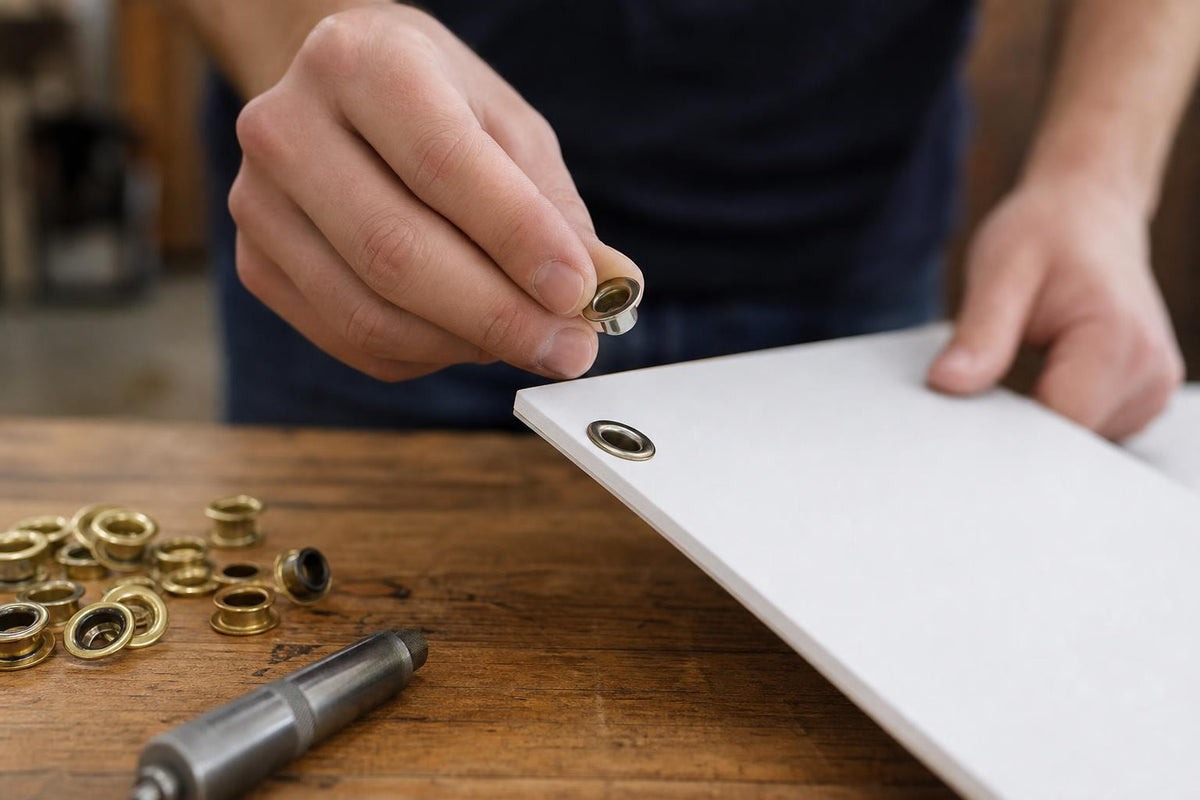
A grommet is a small metal ring set through a material to create a reinforced, tear-resistant hole. In signage, grommets are commonly found on vinyl banners, fabric displays, and rigid signs. On foam board specifically, grommets serve one purpose: they give you a clean, strong attachment point for hanging the board with hooks, rope, wire, chain, or ceiling clips.
Every grommet consists of two pieces, a ring and a washer, placed on opposite sides of the board and compressed together. That two-piece construction is what makes grommets strong enough for signage. The washer on the back insulates the crimped metal edges from cutting into the board material, which is exactly why grommets hold up better than simple punched holes.
Brass is the standard material for foam board grommets because it resists rust and maintains a clean appearance after installation. Stainless steel is another option, though less common in the foam board world. You’ll occasionally see plastic or rubber grommets, but metal is the industry default for signage applications.
Grommet vs. Eyelet: A Common Mix-Up
People frequently confuse grommets with eyelets, and the distinction matters. An eyelet is a single piece of metal that gets folded down to secure itself. A grommet is two separate pieces that snap or press together. The practical difference is strength: grommets are significantly stronger than eyelets and designed for thicker materials and heavier-duty applications. For foam board signage, always use grommets, not eyelets.
As one sign professional on the Signs101 forum confirmed, “a two piece grommet has the washer to insulate the torn and crimped metal edges from tearing into the banner.” That same principle applies to foam core, where the washer protects the relatively soft board from being cut by sharp metal.
Why Foam Board Needs Special Grommets
This is where most people run into trouble, and where most online content falls short.
The Crushing Problem
Standard grommets are engineered for thin materials like vinyl banners, which are typically a fraction of a millimeter thick. Foam board is 3/16" to 1/2" thick. When you try to crimp a standard-barrel grommet through foam core, the barrel isn’t long enough to pass through the material cleanly. The result: the grommet compresses the foam, denting the surface and creating what one source describes as “a nasty looking finish.”
Practitioners on the Signs101 forum (which ranks #1 for this topic) have discussed this problem for years. One sign shop owner shared their experience bluntly: “We have done this before and yes it does crush the foam board a little bit. We used our standard #2 self piercing grommets.” The crushing is cosmetic but noticeable, especially on finished display pieces where presentation matters.
The Solution: Long-Neck and XL Grommets
The fix is straightforward. You need grommets with a longer barrel, often called “long neck” or “XL” grommets. The key measurement is the LUF, which stands for “length under flange.” This is the portion of the grommet that passes through the board material.
Stimpson, one of the major grommet manufacturers, makes extra-long self-piercing grommets with an additional 3/10" of LUF compared to standard grommets. That extra barrel length accommodates materials up to 1/2" thick, including foam board, gator board, and corrugated plastic.
Understanding which foam board thickness you’re working with is essential here. A 3/16" board needs less barrel length than a 1/2" board, but both require more than a standard banner grommet provides.
Common Grommet Sizes for Foam Board
Not all grommets are interchangeable. Here are the specifications that matter:
| Specification | #2 Standard (⅜") | #1XL Brass |
|---|---|---|
| Interior hole diameter | 0.36" | 5/16" (0.3125") |
| Exterior diameter | 0.84" | Slightly smaller profile |
| Best for | Print shop pre-installation | DIY on 3/16" foam core |
| Barrel length | Standard (too short for foam core alone) | Extended LUF for boards up to 1/2" |
The #2 (⅜") grommet is the most common size you’ll encounter when ordering foam board prints from a professional printer. The interior dimension of 0.36" accommodates most standard hooks, thin rope, and wire.
The #1XL brass grommet is the go-to for DIY installation. It’s specifically designed for rigid substrates like foam core and gives you a 5/16" center opening, which is plenty of room for thin cord, line wire, or banner bungees.
If you’re ordering hanging foam board prints from a print shop, you typically won’t need to worry about sourcing the right grommet size. The printer handles that. But if you’re doing it yourself, getting the right XL size is the single most important step.
Grommet Placement Options
Where you position grommets determines how the sign hangs and how much stress each attachment point bears. Standard placement is approximately 0.75" on center from each corner of the board.
Top two corners is the most popular configuration. It works for ceiling hanging, wall hooks, and chain suspension. This is the default for retail aisle signs and most event displays, especially double-sided prints that need to be readable from both directions.
All four corners creates a taut, stretched display. This configuration is ideal for fence mounting, where the board needs to resist wind movement. It’s also used when attaching boards to frames or grid walls at trade shows.
Top center (single grommet) works well for mounting from a single post or hook. The board will hang straight down with even weight distribution, though it’s only practical for smaller boards where a single point can support the weight.
Center (single) allows the board to spin or swing freely from a single suspension point, which is occasionally used for creative retail displays.
For trade show applications, understanding how foam boards perform in those environments helps you pick the right placement and hardware combination.
Grommets vs. Other Hanging Methods
Grommets aren’t always the right choice. Here’s an honest comparison:
| Method | Best For | Trade-off |
|---|---|---|
| Grommets | Ceiling hanging, hook/chain mounting, fence mounting, double-sided displays | Visible metal ring on the board surface |
| Drilled holes (no grommet) | Lightweight hanging with fishing line | No reinforcement; higher risk of tearing through |
| Command strips | Temporary wall displays | No hole needed; limited weight capacity |
| Wall clips | Semi-permanent wall mounting | Clean look, no board modification |
| Easels and stands | Countertop and floor displays | No modification needed |
| Suction cups | Window displays | Works on glass; no hole needed |
When grommets win: You need to hang a board from the ceiling, mount it to a fence, suspend it from chains in a retail environment, or display it double-sided where both faces must be visible. Grommets handle weight better than drilled holes and resist tearing over time.
When alternatives win: For wall-mounted displays, foam board wall clips give you a cleaner look without any board modification. For window signage, suction cup mounts attach directly to glass. For countertop or floor use, triangle feet or easel backs avoid the need for hanging altogether.
One sign professional on Signs101 raised an aesthetic point worth considering: “Downside to grommets: I’ve got a big silver/brass/black ring on my finished product. I’ve also used my paper drill and drilled 1/8” holes in the upper corners for threading fishing line through the holes. That looks really nice too." If the grommet’s appearance bothers you and the board is lightweight, fishing line through a drilled hole can work, but it lacks the tear resistance of a proper grommet.
Installation Tips from Sign Professionals
If you’re installing grommets yourself rather than ordering boards with them pre-installed, here’s what experienced sign makers recommend.
Pre-Drill the Hole
Don’t rely on the grommet to punch cleanly through foam core on its own. Practitioners on the Signs101 forum consistently advise cutting or drilling the hole first: “You do have to cut the hole first by hand or use the old style grommet punch with a hammer, then use a grommet press to put it in.”
The Blue Tape Trick
This is one of the best tips from the professional sign-making community. Before drilling, apply blue painter’s tape over the area where the grommet will go. The tape prevents the paper face of the foam board from tearing or peeling during the drilling process. As one sign pro shared: “If we want no crushing, we blue tape the board and drill a hole and use a long neck grommet.”
Adjust Depth on Your Press
Most grommet presses have a depth adjustment. For foam board, you want enough compression to lock the two pieces together without flattening the foam. “Most grommet machines have a way to set the ‘depth,’ so when you install the grommet you can avoid crushing or deforming the material,” according to practitioners on Signs101.
Test on Scrap
This cannot be overstated. Have extra foam board on hand for practice runs. Every grommet press behaves slightly differently, and the depth sweet spot for foam core takes trial and error to find. One mistake on your finished print is one too many.
Common Use Cases for Grommeted Foam Board
Retail Ceiling and Aisle Signs
This is the most common commercial application. Double-sided foam board prints with grommets hang from ceiling grids using ceiling clips with string or chain-and-hook setups. Grocery stores, pharmacies, and big-box retailers use thousands of these signs. Grommets in the top two corners handle the weight while keeping both printed faces visible.
Trade Show Hanging Displays
Booth spaces often include overhead hanging points. Grommeted foam board provides a lightweight, affordable alternative to heavy rigid panels. Four-corner grommets work well here, since the board can be pulled taut against a backdrop or suspended between poles.
Wedding and Event Signage
A massive DIY use case has emerged in recent years. TikTok and Instagram creators regularly document making welcome signs, seating charts, and directional signage from foam board with grommets. One creator’s workflow: “Designed on Canva, printed on 20x30 foam board at CVS, added grommets at home, and she was ready to hang.” For event planners who want professional results without the DIY grommet headache, ordering boards with grommets already installed saves real time and risk.
Fence-Mounted Directional Signs
Outdoor events, construction sites, and festivals often need signs zip-tied or wired to chain-link fencing. Four-corner grommets distribute the load and prevent the board from tearing loose. For any moisture exposure, pairing grommets with a laminated or waterproof board is smart. You can learn more about choosing a waterproof 3mm board for these types of applications.
Why Many Competitors Don’t Offer Grommets
Here’s something worth knowing if you’re shopping around. Several major online printers either don’t offer grommets on foam board or actively discourage them. Signs.com states: “While it’s possible to add grommets in your foam board sign, we generally do not recommend it.” Vistaprint’s foam board wedding signs FAQ confirms: “Is it possible to add grommets or holes to my wedding sign? Not at this time.”
This means that if you need grommeted foam board, your options are narrower than you might expect. You can either buy a grommet kit and do it yourself (with all the sizing, depth-adjustment, and scrap-testing challenges described above), or you can order from a printer that treats grommets as a standard finishing option.
Order foam board with grommets pre-installed at checkout →
Pairing Grommets with Display Hardware
A grommet is an attachment point, not a complete hanging system. You still need the hardware that connects the grommet to whatever it’s hanging from. S-hook hangers slip directly through grommets and hook onto ceiling grid rails, chains, or wire. For lighter applications, thin cord or fishing line threaded through the grommet opening works well.
If you’re doing a ceiling installation, pair your grommeted boards with ceiling clips that include pre-cut string lengths. For fence or grid-wall mounting, zip ties fed through the grommets are the fastest solution.
The key is matching the hardware to the grommet’s center opening diameter. A #2 grommet with a 0.36" opening accepts most standard hooks and thin cord. If you went with a #1XL at 5/16", just confirm your hardware fits before ordering in bulk.
Ordering Foam Board with Grommets
The easiest path is ordering boards with grommets already installed by your printer. This eliminates the need to source XL grommets, buy or borrow a press, adjust depth settings, and test on scrap material. Professional installation also ensures consistent placement and clean compression without surface damage.
When ordering, you’ll typically select grommets as a finishing option during checkout. Pairing grommets with matte or gloss lamination adds durability and gives the surface extra protection around the grommet area, which is especially useful for signs that will be handled during setup.
For custom grommet placement or unusual configurations, reach out to the print shop directly to confirm what’s possible.
Frequently Asked Questions
What size grommets work on foam board?
The most common size is #2 (⅜") with a 0.36" interior hole diameter. For DIY installation, #1XL brass grommets with an extended barrel (longer LUF) are designed specifically for rigid substrates like foam core up to 1/2" thick.
Will standard banner grommets crush my foam board?
Yes. Standard grommets have barrels designed for thin materials like vinyl. When crimped onto foam board, the barrel is too short, and the compression dents or crushes the foam core. Use long-neck or XL grommets instead.
What’s the difference between a grommet and an eyelet?
A grommet is two pieces (ring plus washer) that press together from both sides. An eyelet is a single piece that folds over. Grommets are stronger, more durable, and the correct choice for foam board signage.
Where should grommets be placed on a foam board sign?
Standard placement is 0.75" on center from each corner. Top two corners is the most common configuration for hanging. All four corners works for fence mounting or taut displays. Top center is used for single-point suspension from posts.
Can I add grommets to foam board myself?
You can, but it requires the right tools and technique. You’ll need XL grommets, a grommet press with depth adjustment, a drill or punch for pre-cutting holes, blue painter’s tape to protect the paper face, and scrap board for testing. Many people find it simpler to order boards with grommets pre-installed.
Do all foam board printers offer grommets?
No. Several major competitors either don’t offer grommets on foam board or recommend against them. If hanging your sign is the goal, confirm that your printer offers grommets as a finishing option before ordering.
What material are foam board grommets made from?
Brass is the industry standard. It resists rust, holds its shape after crimping, and maintains an attractive appearance over time. Stainless steel is an alternative but less commonly offered for foam board applications.
Can grommets be used on double-sided foam board prints?
Absolutely. Double-sided hanging signs are one of the most common use cases for grommeted foam board. The grommet passes through both printed faces, creating a single clean attachment point that leaves both sides fully visible.


