

TLDR
Custom finishing turns a printed foam board into a sign that is actually ready to hang, mount, or display. When ordering, request drilled holes or grommets before production, not after delivery. Specify the placement (top corners, all four corners, center, or custom), the hardware you plan to use, and whether the board needs single or double-sided printing. Getting this right at order time prevents damaged boards, sloppy installations, and last-minute scrambling at the venue.
What Custom Finishing Means for Foam Board Signs
Custom finishing is any production step added after printing that makes a sign easier to install, display, or handle. For foam board signs, the most common finishing choices are drilled holes, grommets, rounded corners, and lamination.
This matters more than most buyers expect. According to Vanderbilt Printing Services, sign finishing directly affects installation and portability, not just appearance. A foam board print without the right finishing is just a print. With the right finishing, it arrives ready to go up on a wall, hang from a ceiling, or sit in a window.
Here are the key terms:
Drilled holes are clean openings cut through the board so the sign can be hung or mounted with screws, standoffs, hooks, chain, string, ribbon, zip ties, or suction-cup hardware.
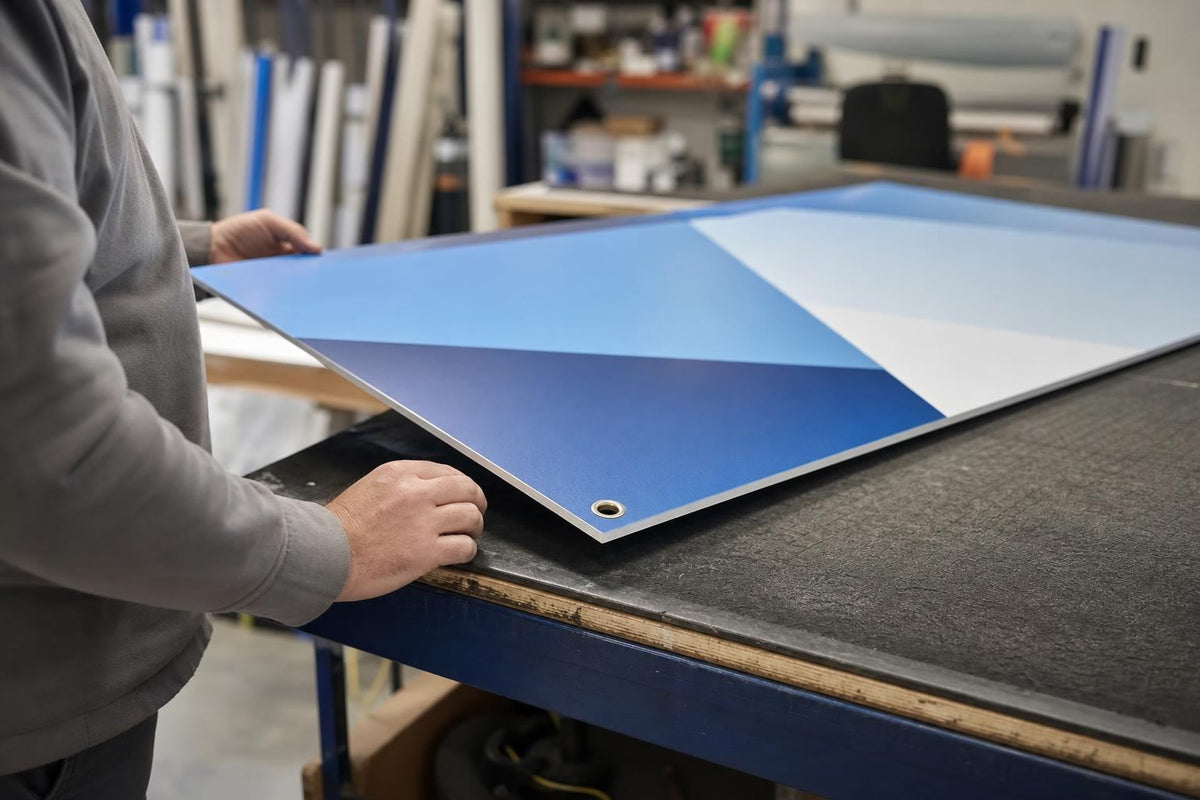
Grommets are metal eyelets installed around a drilled hole to reinforce the opening. Printing industry glossaries define them as metal reinforcements for hanging signs, banners, and displays.
The simplest way to remember: a drilled hole creates the opening, and a grommet reinforces it.
Upload your art and order foam board prints with drilled holes, grommets, or other finishing options built in.
Drilled Holes vs. Grommets: Which Should You Request?
Knowing how to request custom finishing like drilled holes or grommets starts with understanding which one your display method actually needs.
When Drilled Holes Are Enough
Drilled holes work well for most light-duty and moderate-duty installations. If the sign will hang from string, ribbon, small hooks, or S-hooks, a clean hole through the board is usually sufficient. Drilled holes are also the standard choice for wall-mounted standoff hardware, where the standoff barrel passes through the board and holds it away from the wall.
Online printers typically offer hole diameter choices (common sizes include 1/4" and 3/8") along with placement options like top corners, all four corners, top center, or custom locations.
When You Should Request Grommets
Grommets add a metal ring around the hole, which protects the foam board from tearing when hardware repeatedly pulls against the opening. Request grommets when the sign will hang from chain, wire, rope, hooks, or suction-cup hardware, especially in higher-traffic spots where the board might get bumped.
But grommets on foam board are not as simple as grommets on a vinyl banner. Standard brass grommets can crush the foam core during installation. CFS Products explains that standard banner grommets can dent foam core, while longer-barrel (XL) grommets provide more length through thicker board and reduce compression damage. MICRON America confirms that long-neck grommets are designed specifically for thicker substrates like foam core and corrugated plastic.
This is exactly why requesting grommets at order time is better than trying to add them yourself after delivery. For a deeper look at grommet sizing and placement, see this guide on grommet sizes and XL options.
Quick Comparison
| Factor | Drilled Holes | Grommets |
|---|---|---|
| What it is | A clean opening through the board | A metal eyelet installed around the hole |
| Best for | Standoffs, screws, string, ribbon, light hooks | Chain, wire, rope, suction cups, heavy hooks, repeated handling |
| Reinforcement | None | Yes, protects hole from tearing |
| Visual profile | Minimal, nearly invisible | Visible metal ring at each hole |
| Foam board risk | Low if properly cut | Higher if wrong barrel length or press pressure is used |
| Who should do it | Print shop at production | Print shop at production (even more important here) |
How to Request Drilled Holes or Grommets When Ordering Online
This is where most buyers get it wrong. They select the right board size, upload great artwork, and then write “add holes” in the notes without any other detail. That leaves the printer guessing.
Here is exactly what to include when you request custom finishing like drilled holes or grommets:
1. The finishing type. State whether you want drilled holes, grommets, or both.
2. The installation method. Describe how the sign will be displayed: wall screws, standoffs, ceiling hooks, S-hooks, chain, ribbon, zip ties, suction cups, easel, or freestanding holder.
3. Hole or grommet placement. Be specific:
- Top left and top right corners
- All four corners
- Top center only
- Top and bottom center
- Custom placement (describe or mark on your file)
4. Board orientation. Confirm whether the board is horizontal (landscape) or vertical (portrait). This prevents top-corner holes ending up on the wrong edge.
5. Hole diameter or hardware compatibility. If you are matching existing hooks, standoffs, or suction cups, mention the hardware size. Common drilled hole sizes are 1/4" and 3/8".
6. Edge inset, if custom. Many printers place holes a standard distance from the edge (often 3/4" in). If your install requires a different offset, include measurements.
7. Single or double-sided printing. For ceiling-hung, aisle, trade show, or window displays where both sides are visible, double-sided printing is worth considering. Learn more about double-sided printing for aisle signage.
8. A proof note. Use the order notes or proof review step to confirm your finishing details before the board goes into production.
For guidance on matching your print choices with hardware, this article on coordinating print and hardware walks through the process step by step.
Copy-and-Paste Request Examples
One thing competitors almost never provide: actual language you can use when placing your order. Here are request examples you can adapt.
Ceiling-hung retail sign:
“Please print double-sided and add grommets in the top left and top right corners for hanging from ceiling hooks.”
Wall-mounted standoff sign:
“Please add drilled holes in all four corners for standoff hardware. This will be wall mounted in an office lobby.”
Event display on a metal grid:
“Please add drilled holes in the top two corners so we can attach the board to a metal grid with ribbon or zip ties.”
Window sign with suction cups:
“Please add top-corner grommets compatible with suction-cup hardware for a window-mounted display.”
Countertop promotion, no holes needed:
“No drilled holes or grommets needed. This sign will sit on a countertop easel.”
These examples work because they tell the printer three things: what finishing, where, and how the sign will be displayed. That is everything a production team needs to get it right the first time.
Browse hanging foam board sign options with finishing included at order time.
What Placement Should You Choose?
The placement of drilled holes or grommets depends entirely on how and where the sign will be displayed.
Top Corners
The most common choice for hanging signs. Two holes (or grommets) in the upper left and upper right corners support the board from hooks, S-hooks, clips, chain, ribbon, or wire. This works well for ceiling-suspended retail signs, trade show hanging displays, and event signage on grids or rails.
All Four Corners
Best for wall mounting with standoffs or screws, where the board needs to be secured at every corner. Four-point mounting keeps the board flat against the wall and prevents it from shifting or spinning.
Top Center
Useful for smaller signs or shaped signs where two top-corner holes would be too far apart, or when the sign hangs from a single hook or clip.
Custom Placement
When the sign mounts to an existing fixture, grid wall, frame, post, or display system, the hole positions may need to match the hardware exactly. In these cases, describe the locations in your order notes or mark them directly on your artwork file.
Finishing by Display Method
Knowing how the sign will be displayed is the fastest way to figure out how to request custom finishing like drilled holes or grommets. Here is a practical breakdown by use case.
| Display Method | Recommended Finishing Request |
|---|---|
| Ceiling hooks or S-hooks | Top-corner drilled holes or grommets |
| Chain, wire, or rope | Top-corner grommets (reinforcement matters) |
| Wall-mounted standoffs | Drilled holes in all four corners, sized for standoff hardware |
| Suction cups on glass | Grommets or drilled holes compatible with suction-cup hardware |
| Ribbon or zip ties on a grid | Top-corner drilled holes |
| Adhesive strips or Velcro | Usually no holes needed |
| Easel or countertop stand | No holes needed |
| Freestanding floor holder | No holes unless the holder requires them |
| Framed display | No holes; frame holds the board |
Notice that several of the most common display methods do not require holes at all. If the sign will sit on triangle feet or rest in a floor-standing holder, requesting holes just adds visible hardware that does not help anything.
Why You Should Request Finishing Before Production
The most common mistake is not requesting finishing too early. It is requesting it too late.
Foam board is lightweight, rigid, and easy to fabricate in a production environment with the right equipment. But its construction (extruded polystyrene foam bonded between paper facers, according to the manufacturer) means it reacts poorly to improvised drilling or grommeting after the fact.
Practitioners on the Signs101 forum describe real problems when grommeting foam board without proper equipment. In one thread about ceiling-hung retail signs, signmakers warn that grommets can crush foam board if the press depth is wrong or the grommet barrel is too short. Contributors recommend long-neck grommets, careful depth adjustment, and always testing on scrap first.
On The Grumble framing forum, practitioners report similar issues: hammer-style grommet setters can mash foam core, and even careful hand-cutting only works reliably for small quantities with the right tools. The consistent takeaway across both forums is the same: let the print shop handle it during production.
In a Reddit wedding-planning thread, a wedding stationer recommended drilled holes with ribbon or zip ties for mounting a foam board seating chart to a metal grate, noting that tape always carries a risk of the sign falling. This advice applies just as much to business buyers. For grids, rails, fences, and temporary frames at trade shows or events, mechanical attachments through drilled holes beat tape every time.
Common Mistakes to Avoid
1. Waiting until after delivery to add holes. Print shops have calibrated cutting and grommet equipment. A box cutter or hardware-store grommet kit will likely damage the board.
2. Writing “add holes” without specifying placement. The printer cannot read your mind. Include corner positions, edge inset, and orientation.
3. Choosing grommets when an easel or feet would look cleaner. Grommets are a hardware interface, not a decoration. If the sign is not hanging, visible metal rings at the corners may look out of place.
4. Forgetting double-sided printing for hanging signs. If people will see the sign from both directions (ceiling-hung, aisle, open booth, window), a blank back side looks unfinished.
5. Not matching hole size to hardware. If you are using specific standoffs, hooks, or suction cups, the hole diameter needs to fit. Include hardware dimensions in your order notes.
6. Using tape where a mechanical attachment is safer. Tape can fail, especially in warm rooms, humid venues, or high-traffic areas. Drilled holes with zip ties, ribbon, or hooks are more reliable for any sign that matters.
7. Using standard foam board in damp conditions. Paper-faced foam board is positioned as a short-term interior display material. For damp or higher-moisture environments, a waterproof board option is the better choice.
8. Approving the proof without checking finishing notes. The proof review is your last chance to confirm hole placement, grommet positions, and orientation before the board goes into production.
Frequently Asked Questions
Are grommets the same as drilled holes?
No. A drilled hole is the opening through the board. A grommet is a metal eyelet installed around that opening to reinforce it and protect the foam core from tearing. You can have drilled holes without grommets, but you cannot have grommets without holes.
When should I request grommets instead of plain drilled holes?
Request grommets when hooks, rope, wire, chain, zip ties, suction cups, or repeated handling will pull against the hole. The metal eyelet distributes force and prevents the foam from tearing over time. For light-duty hanging with string or ribbon, plain drilled holes are usually sufficient.
Can I add holes after the board arrives?
You can physically do it, but the results are unpredictable. Foam board can crush, dent, or tear if drilled or grommeted with the wrong tool or pressure. If the sign needs to look professional, do not make the first hole after it arrives.
What should I write in the order notes?
Write the placement, the finishing type, and the hardware: “Top two grommets for hanging from S-hooks,” “all four corners drilled for standoffs,” or “top-corner holes for ribbon.” The more specific you are, the less guesswork for the production team.
Do I need holes for an easel or countertop display?
Usually not. If the board will stand on an easel, feet, or countertop holder, holes are unnecessary and may detract from the sign’s appearance.
Should hanging foam board signs be double-sided?
If people will see the sign from both directions, double-sided printing is the better choice. This applies to ceiling-hung retail signs, aisle markers, trade show displays, and window signage.
What hole sizes are standard?
Common drilled hole sizes for foam board signs are 1/4" and 3/8", placed about 3/4" from the edge. If your hardware requires a different size or position, include those measurements with your order.
Does the board thickness affect finishing options?
Yes. Thicker boards (like 1/2" foam core) may need longer-barrel grommets to avoid crushing. Tell the printer your board thickness and display method, and the production team can match the right finishing.
Order Your Foam Board Sign With Finishing Included
The best way to request custom finishing like drilled holes or grommets is to include it when you place your order, not figure it out at the install site. Foam Board Print Shop offers drilled holes, grommets, rounded corners, and lamination as production options on custom foam core prints. Every file gets a manual review and visual proof before production, so your finishing details are confirmed before anything is cut.
Orders placed by midnight ship the next business day with free UPS Ground in the contiguous U.S. If you have questions about hole placement, hardware compatibility, or which finishing option fits your display, the team is available by phone, text, or email.
Upload your art and order directly from Foam Board Print Shop. Include your finishing details with your order so your sign arrives ready to display.


