

TL;DR
Most aisle signage needs double-sided printing. If your sign hangs from the ceiling, projects from a shelf, or sits in the middle of a walkway, shoppers will approach from both directions, so both faces need to be printed. Single-sided is only appropriate when the sign sits flat against a wall or faces one direction at an endcap. The placement determines the answer.
For most store owners and warehouse managers, the question isn’t really about printing preferences. It’s about whether customers can actually read your signs. If someone walks down aisle 7 from the wrong direction and sees a blank white board overhead, that’s not a sign. It’s wasted money.
The good news: the answer to “do I need double-sided printing for aisle signage” is straightforward once you know where the sign is going.
Planning aisle signs for your store or event? Start with hanging foam board prints that ship next business day with free UPS Ground.
What Double-Sided Printing Actually Means
Double-sided printing puts a design on both the front and back faces of a rigid board. The sign reads correctly no matter which direction someone approaches from.
Two things most people don’t realize:
-
You can use different artwork on each side. Most printers, including Foam Board Print Shop, let you submit two separate designs. That means one side of your aisle marker can show the category name (“Cereal & Breakfast”) while the other shows a promotional message or a different category for the adjacent aisle.
-
It costs less than buying two signs. One double-sided board replaces two single-sided boards, cuts your hardware needs in half, and takes up no extra space. For more on designing effective two-sided signs, see this guide on double-sided promotional signs.
When You Need Double-Sided Printing for Aisle Signage
The rule is simple: if people can see both faces, both faces need printing. Here are the specific placements where double-sided is non-negotiable.
Ceiling-Hung Aisle Signs
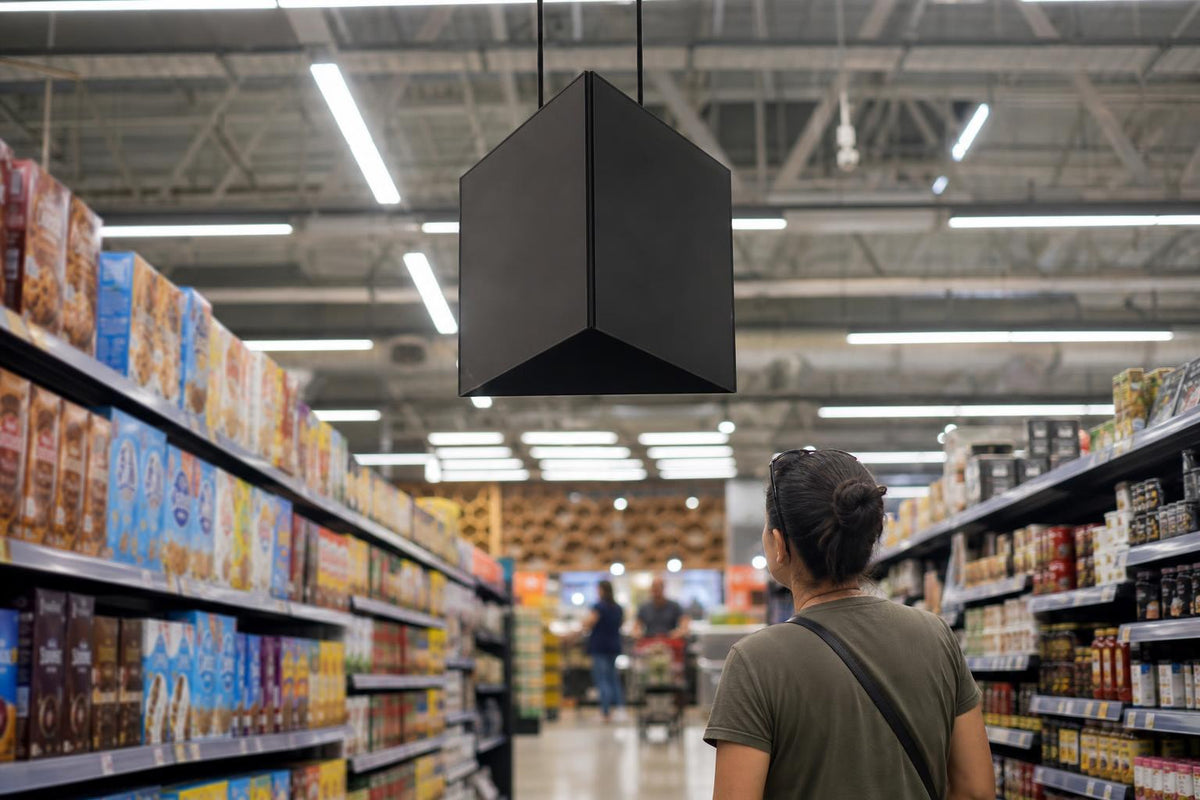
This is the most common aisle sign format in grocery stores, pharmacies, and big-box retail. The sign hangs centered above the aisle, and shoppers see it from both ends. Major chains like CVS, Walgreens, and Rite Aid all use double-sided hanging aisle markers for exactly this reason.
These signs are typically symmetrical and always printed on both sides. Pairing them with ceiling twist clips or S-hook hangers keeps installation clean and secure.
Aisle Violators and Blade Signs
Blade signs mount on shelves and project perpendicularly into the aisle. They’re designed to interrupt the shopper’s line of sight as they walk past, which is why the sign industry calls them “violators.” Since foot traffic flows in both directions, these always need double-sided printing.
Gondola-Mounted Interior Signs
Gondola shelving forms the backbone of most retail store layouts. Interior aisle markers mounted on top of gondola units, often using T-shaped brackets, serve the aisles on both sides. According to USVisual’s design guidelines, interior aisle markers are typically double-sided while perimeter signs are not.
Freestanding Floor Signs
Any sign standing in the middle of an open area (a lobby, a convention hall, a wide retail aisle) will be seen from multiple angles. Double-sided printing is the default. For this type of setup, a floor-standing sign with foam board pairs the print with a stable base.
Warehouse Aisle Markers
Warehouse projecting signs extend perpendicular from racks so forklift operators and pickers can spot them from a distance. These double-sided projecting signs are designed to be visible from two directions by default.
Trade Show and Event Aisles
If your booth sits along an open concourse with traffic flowing both ways, the same logic applies. Booth-facing signage that hangs or stands in the aisle needs double-sided printing. Retail-focused guides tend to ignore this use case, but the principle is identical.
When Single-Sided Aisle Signage Is Fine
Not every sign in a store needs two printed faces. Here are the scenarios where single-sided saves you money without sacrificing visibility.
Endcap Signs
Endcaps face the racetrack (the wide perimeter aisle that loops around the store). Shoppers approach from one direction only. Single-sided works perfectly here.
Wall-Mounted Signs
If the back of the sign sits flush against a wall, nobody will ever see the reverse. Single-sided is the obvious choice. Wall-mounted foam board prints are purpose-built for this.
Single-Approach Corridors
Some store layouts have dead-end aisles or narrow corridors where traffic only flows one way. A sign at the entrance to that corridor only needs one printed face.
Low-Ceiling Stores with Shelf-Mounted Signs
In older buildings or small urban markets where ceiling height makes hanging impractical, signs mounted directly to shelving and facing one direction work fine as single-sided prints.
Decision Matrix: Double-Sided or Single-Sided?
This table gives you the answer at a glance based on sign type and placement.
| Sign Type | Sides Needed | Why |
|---|---|---|
| Hanging/ceiling-suspended over aisle | Double-sided | Visible from both ends of the aisle |
| Aisle violator/blade sign (shelf-perpendicular) | Double-sided | Shoppers approach from both directions |
| Gondola-mounted interior (T-bracket) | Double-sided | Serves aisles on both sides of the gondola |
| Freestanding floor sign in open area | Double-sided | Foot traffic from multiple angles |
| Warehouse projecting aisle sign | Double-sided | Must be readable from both directions |
| Trade show aisle/concourse sign | Double-sided | Open traffic flow both ways |
| Endcap sign facing racetrack | Single-sided | Faces one direction only |
| Wall-mounted perimeter sign | Single-sided | Back is against the wall |
| Single-approach corridor entrance | Single-sided | Traffic flows one way |
No existing guide online organizes this information in one place. Bookmark it.
Why Getting This Right Matters More Than You Think
The decision about double-sided printing for aisle signage isn’t just about convenience. It directly affects how much of your store customers actually experience.
Research from Sorensen et al. (2017) found that the average customer visits only about 23% of a retail store during a shopping trip. Three-quarters of your products never get seen. Effective aisle markers are one of the simplest tools for pulling shoppers deeper into the store.
DGS Retail’s shopping behavior studies show that aisle markers get looked at an average of 26 times in the first 10 minutes of a typical shopping trip. That’s extraordinary exposure for a single sign. And research published on ResearchGate indicates that promotional signs and in-aisle displays attract two to four times the visual attention of the surrounding merchandise.
There’s a financial angle too. Hui et al. (2013) found that a 10% increase in customer path length resulted in a 16.1% increase in unplanned spending. Aisle signs that guide shoppers further into the store don’t just help with wayfinding. They generate revenue.
A single double-sided print doing the work of two signs, getting seen 26+ times in 10 minutes, is one of the best returns on a signage investment you can make.
Choosing the Right Material and Hardware
Material
Foam board is the standard material for retail aisle signage, and for good reason. It’s lightweight (critical for ceiling-hung applications), cost-effective, and takes print beautifully on both sides.
For signs that need to last longer or handle occasional bumps, expanded PVC offers more durability. But for most retail aisle markers that get updated seasonally or for promotional cycles, foam board hits the right balance of quality and value. If you’re unsure about which thickness to choose, this breakdown of foam board thickness for signs covers the tradeoffs.
Adding lamination (matte to reduce glare under fluorescent lights, gloss for brighter color pop) extends the life of the print and protects against dust and handling marks. Practitioners on sign-making forums like Signs101.com regularly confirm that laminated foam board holds up well in retail environments, with one professional noting they’ve hung full 4’ x 8’ sheets using 3M Command adhesive tabs without a single failure.
Mounting Hardware
The sign is only half the equation. Here’s what pairs with each double-sided aisle sign setup:
- Ceiling-hung signs: Use foam board hangers, squeeze clips with string, or ceiling twist clips with string. Adding grommets to the board makes attachment points cleaner and more secure.
- Freestanding signs: A weighted base set keeps double-sided floor signs stable in high-traffic areas without tipping.
- Shelf-perpendicular blade signs: These typically use proprietary shelf-edge clips or T-brackets, but the print itself just needs to be ordered double-sided at the right dimensions.
Order Double-Sided Aisle Signs
Whether you need ceiling-hung markers for a grocery remodel or freestanding signs for a trade show, Foam Board Print Shop offers custom foam board printing with single or double-sided options, grommets or drilled holes for hanging, and matte/gloss/dry-erase lamination. Orders placed by midnight ship the next business day with free UPS Ground.
Upload your artwork and order directly. If you have questions about sizing or hardware, call or text 804-240-4070 for real human support.
Frequently Asked Questions
Does double-sided printing cost twice as much as single-sided?
No. You’re printing on one board instead of buying two separate boards, so the per-side cost is lower than ordering two single-sided prints. You also save on hardware since you only need one set of hangers or clips.
Can I put different designs on each side of my aisle sign?
Yes. Most print shops, including Foam Board Print Shop, accept two different artwork files for the front and back. This is useful for aisle markers where each side faces a different product category, or when you want wayfinding on one side and a promotion on the other.
What thickness works best for double-sided hanging aisle signs?
3/16" foam board is the most popular choice. It’s rigid enough to hang flat without bowing but light enough that standard ceiling clips and hangers support it easily. For larger signs (over 24" x 36"), 1/2" foam board adds stiffness.
How do I hang a double-sided foam board sign from the ceiling?
Add grommets to the top of the board during ordering, then use ceiling twist clips with string or S-hook hangers attached to the ceiling grid. For detailed tips, see this post on coordinating print and hardware.
Do warehouse aisle signs need to be double-sided?
Almost always, yes. Warehouse aisle markers project perpendicular from racks so they can be read from both directions of travel. Single-sided only works if the sign is flat against a wall at the end of a dead-end row.
Should I add lamination to double-sided aisle signs?
For retail environments, yes. Matte lamination reduces glare from overhead fluorescent or LED lighting, and it protects the print from dust and fingerprints. For short-term event signage that will only be up for a day or two, lamination is optional.
Are foam board aisle signs durable enough for long-term use?
Laminated foam board holds up well for weeks to months in a typical retail setting. For permanent signage that needs to last years, expanded PVC or Gatorboard are better options. Most retailers update their aisle signs seasonally, which makes foam board the cost-effective choice.
Do I need double-sided printing for aisle signage at trade shows?
If your sign will be in an open aisle or concourse where attendees approach from both directions, yes. If it’s positioned at your booth back wall, single-sided is sufficient.


