

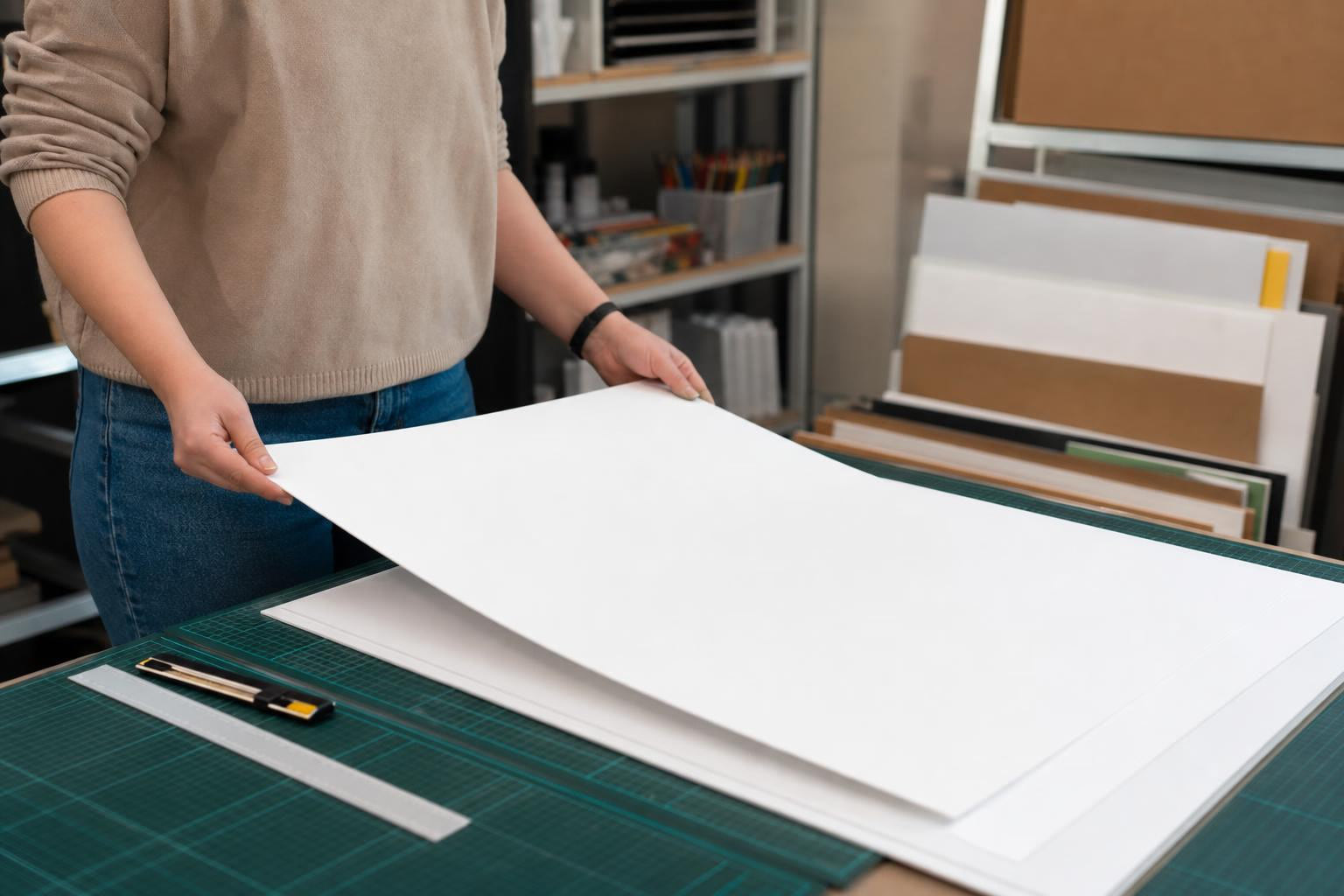
TL;DR
The standard poster board size in the U.S. is 22 × 28 inches. This refers to the single-ply paper board sold at craft and office supply stores. Foam board, a different product entirely, typically comes in 20 × 30 inch sheets, while the most popular size for custom-printed foam boards is 24 × 36 inches. Tri-fold poster boards open to 36 × 48 inches. Knowing which product you actually need matters more than memorizing dimensions.
What Is a Poster Board, and How Big Is It?
A poster board is a single layer of dense, coated paper stock, usually between 10 pt. and 20 pt. in caliper. It bends easily, costs very little, and shows up in every drugstore and office supply aisle in America.
The standard poster board size is 22 × 28 inches (56 × 71 cm). That’s the board you grab for a class presentation, a garage sale sign, or a last-minute birthday message. Two smaller sizes are also common: 14 × 22 inches (the half-size board) and 11 × 14 inches (sometimes called a mini poster board).
Here’s a fact that almost nobody mentions: the 22 × 28 inch dimension isn’t arbitrary. It matches the old Hollywood “Half Sheet,” a card-stock movie poster format that studios printed for theater lobby displays. The Half Sheet was literally half the size of a One Sheet (27 × 41 inches pre-1985), and it was so widely produced that the dimensions became an industry standard for thick paper boards. That’s why your poster board from the craft store is exactly 22 × 28.
If you need something more rigid than paper, you’re probably looking for custom foam board printing rather than a poster board.
Standard Poster Board Sizes: Quick Reference Table
| Category | Size (inches) | Size (cm) | Aspect Ratio | Typical Use |
|---|---|---|---|---|
| Mini poster board | 11 × 14 | 28 × 36 | ~11:14 | Small crafts, mini displays |
| Half poster board | 14 × 22 | 36 × 56 | ~7:11 | School signs, compact projects |
| Standard poster board | 22 × 28 | 56 × 71 | 11:14 | Presentations, classroom displays |
| Foam board (raw sheet) | 20 × 30 | 51 × 76 | 2:3 | Mounting, DIY displays |
| Medium poster print | 18 × 24 | 46 × 61 | 3:4 | Art prints, event posters |
| Large poster / foam board print | 24 × 36 | 61 × 91 | 2:3 | Trade shows, retail, dorm posters |
| Movie one-sheet (modern) | 27 × 40 | 69 × 102 | ~2:3 | Theater displays |
| Tri-fold board (open) | 36 × 48 | 91 × 122 | 3:4 | Science fairs, conferences |
| Bus stop / 2-sheet | 40 × 60 | 102 × 152 | 2:3 | Transit advertising |
| Max custom foam board | 48 × 96 | 122 × 244 | 1:2 | Full-scale retail walls |
Notice the aspect ratio column. A standard 22 × 28 poster board has an 11:14 ratio. A 24 × 36 printed poster is 2:3. If you design artwork for one format and try to print it on the other, you’ll end up cropping edges or adding borders. Always confirm the aspect ratio of your target size before starting your design.
Poster Board vs. Foam Board vs. Poster Print
This is the single biggest point of confusion when people search for poster board sizes. Three different products use similar names, come in different default sizes, and serve different purposes. Here’s how they break down.
Poster Board
A single layer of coated paper stock. Flexible, lightweight, cheap. The standard size is 22 × 28 inches. It bends and warps easily, which makes it fine for a one-day classroom presentation but problematic for anything meant to last more than a week.
Foam Board
A three-layer sandwich: paper face, polystyrene foam core, paper back. The foam core makes it rigid and resistant to bending. Raw foam board sheets (the kind you buy at an art supply store) typically measure 20 × 30 inches and come in 3/16-inch thickness with white or black cores.
Custom-printed foam boards are a different story. The most popular printed foam board size is 24 × 36 inches, but printing shops can cut to virtually any dimension. Foam Board Print Shop, for example, offers custom sizes up to 4 ft × 8 ft in thicknesses of 1/8", 3/16", or 1/2", plus a 3 mm waterproof board option for damp environments. Learn more about what foam board is and when each thickness makes sense.
Poster Print
This is just the printed output, not the substrate. A poster print can go on paper, foam board, vinyl, or canvas. Common poster print sizes in the U.S. include 18 × 24, 24 × 36, and 27 × 40 inches (the movie one-sheet).
The bottom line: when someone says “poster board size,” they usually mean 22 × 28. When they say “foam board size,” they usually mean 20 × 30 (raw) or 24 × 36 (printed). These are not interchangeable numbers.
Tri-Fold Poster Board Sizes
Tri-fold boards deserve their own section because people frequently confuse them with flat poster boards.
A standard tri-fold poster board measures 36 inches tall × 48 inches wide when fully open. Folded, it becomes approximately 36 × 24 inches, making it easy to carry and capable of standing upright on a table without an easel.
A smaller tri-fold option measures 28 × 40 inches open. If you’re preparing for a science fair, always check that competition’s specific size requirements. ISEF and many regional fairs have their own dimension limits that may differ from the standard 36 × 48.
Practitioners on Reddit frequently note that science fair tri-fold boards get damaged in transit. If durability matters, printing your panels on rigid foam board and attaching them to a sturdier backing gives a more professional result. For tabletop presentations, a countertop foam board display can serve as a cleaner alternative to the classic tri-fold.
Common Poster Sizes for Printing
If you’re printing a poster (on any material), these are the standard sizes used across the U.S.:
Small formats:
- 8.5 × 11 inches (letter size, basic flyers)
- 11 × 17 inches (tabloid, in-store signage)
- 12 × 18 inches (small event posters)
Medium formats:
- 16 × 20 inches (art prints, photo enlargements)
- 18 × 24 inches (the workhorse event and retail poster)
Large formats:
- 24 × 36 inches (the most popular large poster size, dorm posters, trade show boards)
- 27 × 40 inches (modern movie one-sheet, standard since 1985)
- 36 × 48 inches (conference posters, large retail displays)
- 48 × 96 inches (full wall panels, trade show backdrops)
The 24 × 36 size dominates because it’s large enough to read from across a room but small enough to ship and display without special equipment. At trade shows, 36 × 48 and larger formats are more common.
For oversized applications like retail walls or trade show booths, custom foam board printing handles sizes that store-bought poster boards simply can’t match. You can also go beyond rectangles with options like foam board standees and cutouts.
Movie Poster Sizes
Movie poster sizes deserve a quick note because they come up constantly in poster board size discussions.
The modern U.S. movie one-sheet is 27 × 40 inches. Before 1985, it was 27 × 41. The retail movie posters sold at stores and online are typically 24 × 36 inches, not the full one-sheet size.
The historical connection between the 22 × 28 poster board and the old movie Half Sheet is genuinely interesting. Studios printed Half Sheets on card stock for lobby displays, often producing two different artwork styles per film. Collectors still trade in this format. The fact that your local Walgreens sells boards in this exact size is a direct inheritance from mid-20th-century Hollywood printing standards.
International Poster Sizes (ISO A-Series)
Outside the United States, poster sizes follow the ISO 216 standard. Every size in the A-series maintains a 1:√2 aspect ratio, which means folding any sheet in half produces the next smaller size.
| ISO Size | Dimensions (mm) | Dimensions (inches) | Closest U.S. Equivalent |
|---|---|---|---|
| A4 | 210 × 297 | 8.3 × 11.7 | Letter (8.5 × 11) |
| A3 | 297 × 420 | 11.7 × 16.5 | Tabloid (11 × 17) |
| A2 | 420 × 594 | 16.5 × 23.4 | 18 × 24 (approximate) |
| A1 | 594 × 841 | 23.4 × 33.1 | 24 × 36 (close but not exact) |
| A0 | 841 × 1189 | 33.1 × 46.8 | 36 × 48 (approximate) |
A1 is the closest international match to the popular U.S. 24 × 36 format, but the dimensions don’t align perfectly. If you’re designing for international distribution, confirm which standard your printer uses before finalizing artwork.
How to Choose the Right Poster Board Size
Picking the right size comes down to four factors.
Purpose
A school presentation works fine on a standard 22 × 28 poster board. A trade show display needs at least 24 × 36, and often 36 × 48 or larger. Courtroom exhibit boards are typically 24 × 36 or 30 × 40 on rigid foam board with matte lamination to prevent glare. For courtroom-specific guidance, see this exhibit display preparation guide.
Viewing Distance
A practical rule of thumb: text should be at least one inch tall for every 10 feet of viewing distance. A poster read from 2 to 3 feet away (like a hallway flyer) can use smaller fonts on a smaller board. A sign viewed from across a trade show floor at 20 feet needs headline text that’s at least 2 inches tall, which generally means a board of 24 × 36 or bigger.
Display Method
How you plan to mount or stand the poster affects which size and material you choose. A paper poster board can lean against a wall. A foam board can stand upright with triangle feet, hang from the ceiling with grommets, or mount flush to a wall with standoffs. Larger boards (36 × 48 and up) often need floor-standing sign holders or easel stands.
For window-facing retail signs, window-mounted foam board prints with suction cup hardware are a cleaner solution than taping a poster board to glass.
Durability
Paper poster boards last days. Foam board prints last months to years indoors, especially with lamination. If you need a reusable sign (think meeting room schedules or pricing menus), a custom dry-erase board on foam core is worth considering.
File Setup Tips by Poster Board Size
Getting your dimensions right matters less if your file isn’t set up properly for print. Here are the essentials.
Resolution (DPI)
For professional printing, 300 DPI is the gold standard at smaller sizes (up to about 16 × 20 inches). For larger formats like 24 × 36 and above, 150 to 200 DPI produces sharp results because viewers stand farther away. Practitioners on Reddit’s r/ProCreate and r/Lightroom communities regularly confirm that a 24 × 36 board on an easel, viewed from four to six feet, looks perfectly sharp at 150 DPI.
For detailed file setup guidance, this article on recommended DPI for large foam board prints walks through the specifics.
Bleed
All print files should include a bleed margin of at least 0.125 inches (1/8 inch) on every side. This means an 18 × 24 poster should be designed at 18.25 × 24.25 inches to ensure full-bleed color extends to the edges after trimming. For a deeper walkthrough, check this guide on setting bleed for large format prints.
Color Mode
Design in CMYK, not RGB. Monitors display RGB, but printers use CMYK ink. Converting at the end of the design process can shift colors noticeably, especially blues and greens. Convert early or, better yet, start in CMYK.
File Format
PDF, TIFF, and high-quality JPEG are the safest formats for print. Avoid PNG for large formats (the file sizes become unwieldy) and never submit a low-resolution screen grab.
When Store-Bought Poster Boards Aren’t Enough
Standard poster board sizes work for simple, short-term projects. But they have real limitations: fixed sizes, thin material, no lamination, no finishing options.
Custom foam board printing removes those constraints. You can order any size (not just the three or four options at the craft store), choose your thickness, add matte or gloss lamination for durability, and get finishing touches like rounded corners, drilled holes, or grommets that make the board ready to hang the moment it arrives.
Order a custom-size foam board print in any dimension up to 4 ft × 8 ft, with next-business-day production and free UPS Ground shipping.
Frequently Asked Questions
What is the standard poster board size?
The standard poster board size in the United States is 22 × 28 inches (56 × 71 cm). This is the single-ply paper board commonly sold at office supply stores, drugstores, and craft shops. Smaller options include 14 × 22 and 11 × 14 inches.
What is the most common foam board print size?
The most popular size for custom-printed foam boards is 24 × 36 inches. This gives enough space for detailed graphics while remaining easy to transport and display. Raw (unprinted) foam board sheets typically come in 20 × 30 inches.
What size is a tri-fold poster board?
A standard tri-fold poster board is 36 × 48 inches when fully opened and approximately 36 × 24 inches when folded. The folding panels allow it to stand upright on a table without support.
Are poster board and foam board the same thing?
No. Poster board is a single layer of thick paper that bends easily. Foam board is a rigid three-layer material (paper, polystyrene foam core, paper) that resists bending and warping. They come in different standard sizes and serve different purposes.
What size is a standard movie poster?
The modern U.S. movie one-sheet is 27 × 40 inches (it was 27 × 41 before 1985). Retail movie posters sold at stores are usually 24 × 36 inches, which is smaller than the actual theater format.
What DPI should I use for a poster?
Use 300 DPI for posters 16 × 20 inches and smaller. For larger formats like 24 × 36 and above, 150 to 200 DPI produces sharp results because these boards are typically viewed from several feet away.
How much bleed should I add to a poster file?
Add at least 0.125 inches (1/8 inch) of bleed on all four sides. This extra margin ensures your design extends to the very edge of the finished print after trimming.
What is the largest size you can print on foam board?
Foam Board Print Shop offers custom foam board printing up to 4 ft × 8 ft (48 × 96 inches), which covers everything from small countertop signs to full-scale trade show walls and retail displays.


