

TL;DR
Foam board corners crush because the polystyrene core is 95-98% air with only about 35 psi of compressive strength. Corners concentrate impact energy at a single point instead of spreading it across the board’s face, and once the foam cells collapse, the damage is permanent. You can prevent corner crush by ordering thicker board stock, choosing rounded corners, adding lamination, and using proper corner protectors during transport.
Foam board is one of the most popular materials for trade show displays, event signage, courtroom exhibits, and retail graphics. It prints beautifully, ships affordably, and weighs almost nothing. But it has a well-known weakness: the corners.
If you’ve ever unpacked a foam board sign to find soft, dented corners, or watched the edges get dinged just from placing a board on an easel, you’re dealing with a structural problem baked into the material itself. Understanding what causes foam board corners to crush and how to prevent it starts with knowing what foam board actually is, at a material level.
Ready to order boards built to resist corner damage? Configure your print with thicker stock, rounded corners, and lamination options.
What Is Foam Board, and Why Are Corners So Fragile?
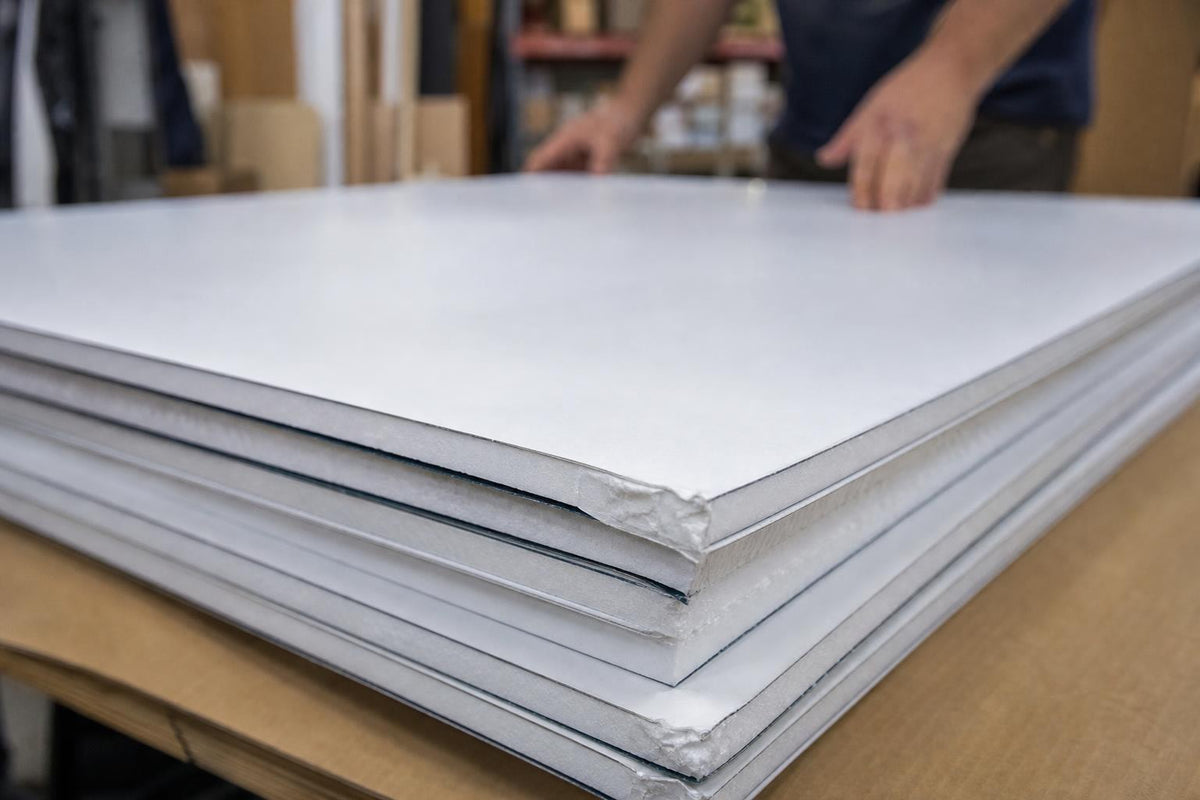
Foam board is a sandwich material. Two clay-coated paper liners sit on either side of a rigid polystyrene foam core. Think of it as a paper sandwich, not a plastic panel. The paper liners provide stiffness and a printable surface. The foam core keeps the two skins apart, giving the board its thickness and light weight.
Here’s the critical detail: polystyrene foam is 95% to 98% air. At the densities used in standard sign-grade foam core (1.5 to 2.5 lb/ft³), the compressive strength tops out around 35 psi. That’s enough to hold the board rigid when forces are distributed evenly across a flat surface. It’s not enough to survive a concentrated hit at a corner.
A US patent for foam board corner protectors puts the problem plainly: the surface is “soft and highly susceptible to denting and the unprotected corners are very easily crushed.” This isn’t a manufacturing defect. It’s a fundamental property of the material.
Why Corners Specifically?
When something strikes the flat face of a foam board, the force spreads across a wide area. The paper liners flex slightly, the foam compresses elastically, and the board recovers. Corners don’t have that luxury.
A corner is the structural junction point where two edges meet at 90 degrees. When impact energy hits that intersection, it concentrates at a single point rather than distributing across a face. Packaging engineers describe this clearly: flat areas of a panel deform elastically upon impact, but corners “lack this flexibility” and “usually react to external influences with plastic deformation,” meaning they remain permanently damaged or break entirely.
This is why a crushed foam board corner never springs back.
Key Terms You Should Know
Corner Crush
The event itself. Corner crush occurs when the polystyrene foam cells at a board’s corner are compressed past their yield point, collapsing the cellular structure and permanently reducing the board’s thickness at that spot.
Pillowing
An industry term for the visible result of corner crush. When a corner gets smashed, the paper liner separates from or compresses the foam underneath, creating a soft, rounded dent. Corner protectors exist specifically to prevent foam board corners from “pillowing” or getting dinged during handling.
Compression Set
The reason the damage can’t be undone. When foam core has been compressed past its yield point, “the resiliency of the foam core can be compromised” and the thickness is “irreversibly reduced from its normal thickness.” The air pockets in the polystyrene collapse permanently. You can’t push out a dented corner any more than you can un-pop a balloon.
Common Causes of Corner Crush on Foam Boards
Understanding what causes foam board corners to crush helps you target prevention at the right stage. The damage comes from five main sources.
1. Shipping Impacts
This is the number one cause. Period.
Foam boards travel through carrier networks on conveyor belts, get loaded and unloaded from trucks, and occasionally get dropped. The box hits a corner or edge during transit, and the energy transfers straight through to the board.
Practitioners on the Signs101.com forum are blunt about this reality. One professional sign maker described spending significant time “fabricating our own shipping ‘box’ for each order with mixed results after UPS gets done with it.” Another experienced pro shared a telling recommendation: put “GLASS stickers all over the box (not fragile, as that doesn’t work as well)” because carriers reportedly treat those packages with more care.
For detailed packing guidance, our guide on how to pack foam board for shipping walks through the process step by step.
2. Event and Trade Show Transport
Even boards that arrive perfectly can get damaged on the way to an event. Loading boards into a car trunk, leaning them against walls, carrying them through doorways, stacking them with other supplies: each moment of handling is a chance for corner contact.
One customer review on a competitor’s site captures the frustration perfectly: “The photo quality was good but the corners were getting distressed even just with handling it to put it on the easel.” Foam core is so fragile that even a soft hit to the board can leave noticeable damage. Boards used for trade show displays are especially vulnerable because they make multiple trips.
3. Humidity and Moisture
Foam board will absorb moisture from the environment, causing the sign to warp, bulge, discolor, or even tear. Humidity levels above 70% can significantly increase warping risk. But there’s a corner-specific problem too: when the paper liners soften from absorbed moisture, they lose their stiffness, making corners even more susceptible to crush from minor impacts that they’d normally survive.
4. Improper Stacking and Storage
Boards stacked unevenly or stored with heavy items on top put constant pressure on corners. Optimal storage conditions are temperatures between 65 and 75 degrees Fahrenheit with relative humidity levels of 40 to 60%. Boards stored outside this range, especially in damp basements or hot garages, degrade faster.
5. Minor Contact During Setup
This one catches people off guard. Simply sliding a board into a display stand, propping it against a table edge, or bumping a corner against a doorframe can be enough. The compressive strength of the foam is so low that forces you wouldn’t think twice about can cause permanent damage.
How to Prevent Corner Crush Before You Order
The most effective prevention happens at the ordering stage, before the board is even printed. These choices are built into the product.
Choose Thicker Board Stock
Standard foam board is 3/16 inch thick. It’s the everyday workhorse for posters, presentations, and single-use signs. But if your board needs to travel, stand on its own, or survive more than one event, step up to half-inch stock.
Thicker generally equals more durable. The additional foam depth gives corners more material to absorb impact before the paper liners are affected. For boards larger than 30x40 inches or any board that will be reused, half-inch is the practical choice. Our guide to choosing foam core thickness breaks down when each option makes sense.
Order Rounded Corners Instead of Square
This is one of the simplest and most overlooked solutions. A sharp 90-degree corner creates the exact geometric point where impact energy concentrates. Rounded corners eliminate that vulnerable intersection entirely, distributing any edge contact along a curve instead of focusing it at a single point.
Rounded corners also reduce the chance of catching on packaging, clothing, or display hardware during handling. They’re a functional upgrade disguised as an aesthetic one.
Add Lamination
Lamination applies a thin protective film over the printed surface that extends to the edges. This added layer bridges the paper-foam boundary and reinforces the corners with a material that’s tougher than the paper liner alone.
Matte lamination works well for events and courtroom exhibits where glare control matters. Gloss lamination is popular for retail displays and art prints. Either option adds meaningful protection against scratches, scuffs, and light corner damage during transit.
Consider Waterproof PVC Board for Tough Environments
For situations involving moisture, frequent handling, or repeated transport, traditional foam core may not be the right substrate. A 3 mm waterproof PVC board is inherently resistant to moisture absorption, preventing water from penetrating the board’s interior. It maintains its structural integrity where foam core would soften and fail. If you’re placing boards in restaurant or kitchen settings, this option eliminates the moisture-weakened-corner problem entirely.
How to Protect Foam Boards After They Arrive
Even well-made boards need careful handling. These steps protect corners from the moment you open the box.
Use Corner Protectors for Transport
Plastic or foam corner protectors slide onto each corner of the board and absorb impact that would otherwise go straight into the polystyrene core. They come sized by board thickness: 3/16 to 1/4 inch, 1/4 to 3/8 inch, and 3/8 to 1/2 inch. Use the right size for a snug fit.
Corner protectors are especially popular for businesses preparing for trade shows. You can use them during transport and remove them for display, or leave them on if the board’s back corners aren’t visible.
The Cardboard Sandwich Method
A technique widely used by professional sign shops: sandwich the foam board between two pieces of rigid cardboard before adding any foam corner inserts or placing it in a box. The cardboard layers distribute pressure across the full surface of the board, shielding the corners from point impacts.
One Signs101 forum member recommends this approach specifically, along with keeping “cushioning keeping it away from the box wall” to isolate the board from whatever happens to the outer box during shipping.
Use Display Hardware Instead of Leaning
Leaning a foam board against a wall, table, or chair is the fastest way to ding a bottom corner. Display hardware solves this. Triangle feet hold the board upright without any corner contact against furniture. Wall clips mount the board flat, keeping all four corners safely off the floor. Easel stands cradle the board at controlled angles.
The point is to minimize the number of times someone picks up, leans, or repositions the board by hand.
Store Boards Flat in Controlled Conditions
Stack boards flat (not on their edges) in a dry space between 65 and 75 degrees Fahrenheit. Keep relative humidity between 40% and 60%. Never stack heavy objects on top of foam boards, and avoid placing anything directly on a board’s corners.
When to Choose a Different Substrate Entirely
Foam core is ideal for short-term, single-use, or light-duty indoor signage. If your situation demands more, it’s worth considering alternatives.
For repeated trade show use, gator board (a foam core with rigid wood-fiber facers instead of paper) handles the wear of multiple events far better. It costs more, but the per-use cost drops quickly when you’re not replacing crushed boards after each show. Our foam board vs. gator board comparison covers the cost and durability tradeoffs.
For moisture-prone indoor spaces, the 3 mm waterproof board mentioned earlier avoids the humidity degradation that softens foam core and makes corners fragile.
For permanent displays, framing the board protects all four corners behind a rigid border. Framed foam board prints armor the edges permanently and give the piece a finished, professional look that also happens to solve the corner crush problem completely.
A veteran sign maker on Signs101 put it bluntly: “even if it gets there without any damage, they’ll wreck it taking it outta the box and blame you.” For high-stakes presentations where corner damage isn’t an option, choosing a sturdier substrate or adding a frame is the safest path.
Quick Reference: Prevention at Every Stage
| Stage | What to Do |
|---|---|
| Ordering | Choose 1/2" stock, rounded corners, lamination |
| Shipping | Cardboard sandwich, foam corner inserts, tight box, GLASS stickers |
| Receiving | Inspect corners immediately, photograph any damage for claims |
| Transport | Slide-on corner protectors, flat carry (never on edge) |
| Display | Use hardware (feet, clips, easels) instead of leaning |
| Storage | Flat stacking, 65-75°F, 40-60% humidity, no weight on corners |
Need boards that resist corner crush from the start? Upload your artwork and configure rounded corners, your preferred thickness, and lamination at checkout. Orders placed by midnight ship the next business day with free UPS Ground.
Frequently Asked Questions
Can you fix a crushed foam board corner?
No. Once the polystyrene foam cells collapse, the damage is permanent. The foam undergoes what’s called compression set, where the cellular structure is irreversibly reduced in thickness. You can’t push, heat, or steam the dent back out. Prevention is the only real fix.
Do corner protectors actually work?
Yes, when sized correctly for the board’s thickness. Corner protectors absorb and distribute the impact energy that would otherwise concentrate at the 90-degree junction point. They’re particularly effective during transport and should be removed only when the board is ready for display.
Does lamination prevent corner crush?
Lamination reduces the severity of minor corner damage by adding a tougher film layer over the paper liner. It won’t stop a hard drop from crushing the polystyrene core, but it bridges the paper-foam boundary and helps resist the light bumps, scuffs, and handling contact that cause pillowing during normal use.
Is half-inch foam board worth the extra cost for trade shows?
For boards that need to travel to multiple events, half-inch board is almost always worth it. The additional thickness provides significantly more material at each corner to absorb impact. Paired with rounded corners and lamination, half-inch stock dramatically reduces the chance of visible corner damage after transit.
Why do shippers recommend GLASS stickers instead of FRAGILE?
Experienced sign shippers on forums like Signs101 report that carriers treat packages labeled GLASS with noticeably more care than those labeled FRAGILE. The theory is that FRAGILE has become so common it’s essentially ignored, while GLASS implies breakable contents that will result in a damage claim. This practitioner tip is widely shared among professional sign makers.
What’s the best thickness for a foam board that won’t travel?
For boards that stay in one location (wall displays, in-store signage, presentation boards), 3/16 inch is the standard and works well. It’s lightweight, cost-effective, and perfectly rigid for stationary use. The corners are still vulnerable to careless handling, so consider rounded corners as a low-cost precaution.
Should I just use gator board instead of foam core?
If your boards need to survive repeated transport, gator board is the more durable option. Its wood-fiber facers are much harder than paper liners, making corners significantly more resistant to crush. But for single-use signage, presentations, or boards that stay put, foam core with the right finishing options is the more cost-effective choice.
How should I carry foam boards to avoid corner damage?
Carry boards flat with both hands, keeping them parallel to the ground. Never carry a board on its edge or tuck it under one arm. If moving multiple boards, place rigid cardboard between them and wrap the stack with corner protectors. Use a portfolio case or flat transport bag for boards heading to events.


