

TL;DR
Crushed corners are the most common shipping damage for foam board prints, caused by the exposed polystyrene core absorbing impact at vulnerable edge intersections. Preventing it requires the right combination of corner protectors, double-wall corrugated boxes, the corrugated sandwich method, and proper void fill. This guide defines every packaging term you need to know so you can pack foam boards yourself or recognize whether your print vendor actually knows what they’re doing.
Why Foam Board Corners Crush in Transit (And Why It Matters)
Roughly 3-4% of all packages shipped in the U.S. arrive with some form of damage. That’s about 1 in 25 shipments. For flat, rigid items like foam board prints, the practical rate runs higher because standard carrier handling concentrates force on corners and edges.
The reason is structural. Foam board has a polystyrene foam core sandwiched between clay-coated paper facers. At any corner, that soft core is exposed on two sides simultaneously, making it the weakest point on the entire board. Drop a box on its corner (which happens constantly on conveyor belts and in delivery trucks), and the foam compresses permanently. The print is ruined.
This isn’t a minor annoyance. Research shows that 51% of consumers won’t reorder from a company after receiving damaged goods. If you’re shipping foam board prints for a trade show, courtroom presentation, or retail display, a crushed corner means missed deadlines and wasted money.
Understanding how to pack foam board for shipping to avoid crushed corners starts with learning the vocabulary of proper packaging. Every term below connects directly to preventing that damage.
Order custom foam board prints from a shop that already packages them correctly so you can skip the guesswork.
Damage Types You Need to Know
Crushed Corner
The most frequent failure mode. Happens when impact force hits the point where two edges meet. The foam core compresses, the paper facer tears or dimples, and the printed surface is permanently dented. Once a foam board corner crushes, there’s no fixing it.
Practitioners on the Signs101 forum (a professional sign-industry community) report that even experienced shippers see damage on roughly 1 in 30 foam board shipments during normal periods. During holiday and peak seasons, that rate climbs to about 1 in 25.
Bowing and Warping
Different from corner crush but often shows up alongside it. Foam board absorbs moisture, making it warp when exposed to humidity or heat. Ideal conditions are 68-75°F with humidity between 45-50%. Inside a hot delivery truck in July, conditions can far exceed those numbers. A board that left the printer perfectly flat can arrive with a visible bow.
This matters especially for wall-mounted foam board prints that need to hang flush against a surface. Even slight warping is obvious once the board is on display.
Puncture
A hole or deep gouge through the printed face and into the foam core. Usually caused by sharp objects in adjacent packages or by the board shifting inside an oversized box until a corner of the box itself punches through.
Denting and Creasing
Surface-level damage where the paper facer compresses without fully breaking through. Common when boards are stacked without separator sheets or when heavy objects press against the face during transit. Glossy and matte laminated surfaces show dents more visibly than uncoated boards.
Protective Materials: What They Are and Why They Matter
Corner Protector (EPS Foam Corner)
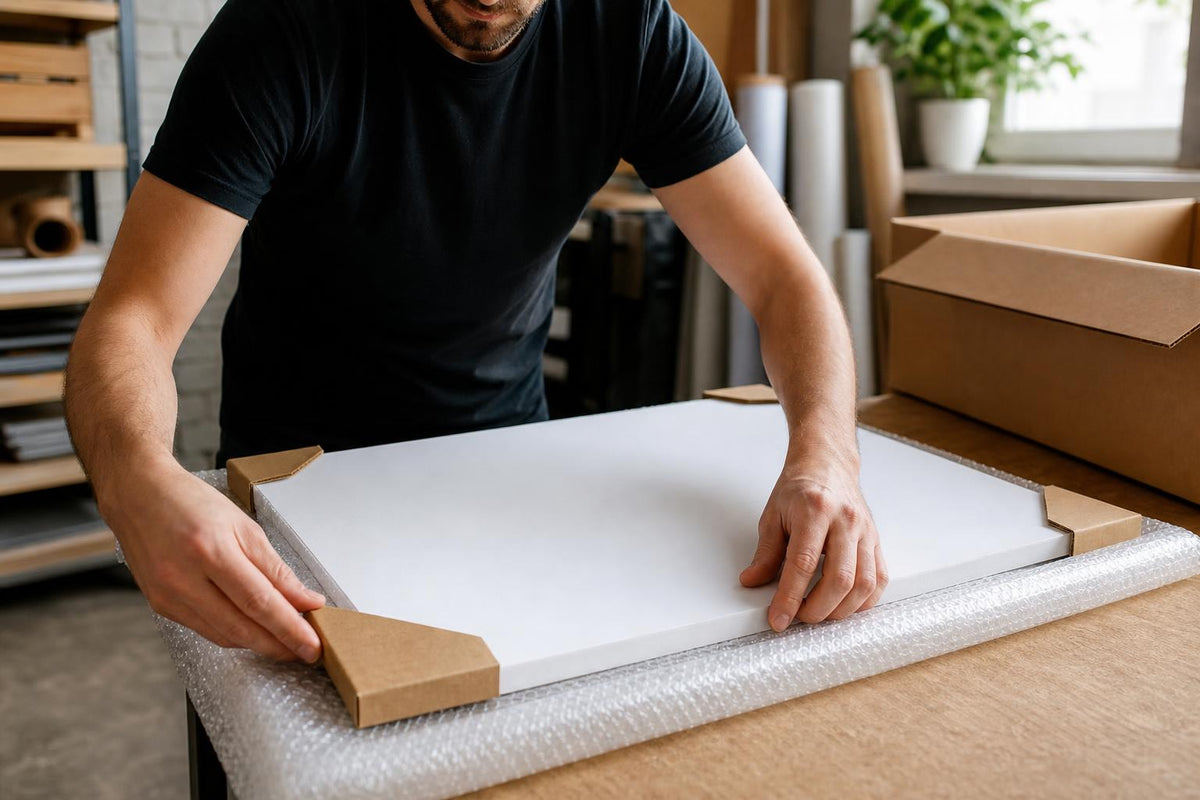
Small L-shaped or triangular pieces made from expanded polystyrene (EPS) that cap each corner of the board. They absorb impact energy before it reaches the board itself. Foam corner protectors are the single most important material for preventing crushed corners on foam board shipments.
One sign professional on Signs101 described their standard method: “double wall cardboard boxes, foam corners, and outer corner protectors and a hell of a lot of filpak.” This layered approach, with foam corners as the foundation, is what experienced shippers rely on.
Edge Protector (U-Profile and L-Profile)
While corner protectors cap the points, edge protectors run along the full length of a board’s edges. A U-profile wraps around three sides of an edge (top, bottom, and the edge itself), providing protection along the entire perimeter. An L-profile covers two sides.
For larger boards, especially hanging foam board prints with grommets that add hardware weight to the edges, full-length edge protection prevents the kind of mid-edge denting that corner protectors alone can’t address.
Corrugated Sandwich
This is a practitioner technique, not a product you buy off a shelf. You cut two pieces of corrugated cardboard slightly larger than the foam board (a quarter-inch on each side is standard) and sandwich the board between them before adding corner protectors and boxing it up.
A sign professional on Signs101 explained the specific method: “Sandwich the foam core with two pieces of 24.25x36.25” cardboard before adding the foam corners. Put GLASS stickers all over the box (not fragile, as that doesn’t work as well)."
The corrugated sandwich distributes impact across the full board surface rather than letting it concentrate at corners. It’s one of the most effective ways to pack foam board for shipping to avoid crushed corners, and it costs almost nothing.
Bubble Wrap (Air-Encapsulated Plastic)
UPS guidelines recommend using bubble wrap “to protect and cushion lightweight items by applying multiple wraps and layers to ensure that the item is completely protected, especially on corners and edges.” For foam board, bubble wrap works best as an additional layer around the corrugated sandwich rather than as the primary protection. On its own, it doesn’t provide enough rigidity to prevent corner crush from heavy impacts.
Void Fill
Any material used to fill empty space inside a shipping box. Options include kraft paper, packing peanuts, air pillows, and FillPak (crumpled paper dispensed from a machine). The purpose is simple: prevent the board from shifting during transit.
This is critical because oversized boxes are a leading cause of in-transit damage. When an item occupies less than 70% of a box by volume, it has room to shift, rotate, and bounce. Every time the board slides and hits the box wall, the corners take the brunt.
Foam Frame Protector
A closed-cell foam piece shaped to wrap around the entire perimeter of a framed piece. Relevant when shipping framed foam board prints, where the frame corners and glass (or acrylic) face need protection beyond what standard corner protectors provide. These are bulkier and more expensive than EPS corners, but necessary for framed items.
Box Specifications: The Terms That Determine Whether Your Board Survives
Edge Crush Test (ECT) Rating
ECT measures how much compressive force a corrugated board can withstand on its edge before it buckles. It’s expressed in pounds per linear inch. Single-wall corrugated rated at 32 ECT handles packages under about 20 pounds. For fragile items like foam board, double-wall rated at 44 ECT or higher is the safer choice.
When evaluating how a vendor packages your order, ask about their box rating. A printer using 32 ECT single-wall boxes for foam board is cutting corners (no pun intended).
Single-Wall vs. Double-Wall Corrugated
Single-wall corrugated has one fluted layer between two paper liners. It’s the most common shipping box material and works fine for sturdy, non-fragile items. Double-wall corrugated has two fluted layers and three liners, making it substantially more rigid and crush-resistant.
Multiple sign professionals recommend double-wall specifically for foam board. As one practitioner on Signs101 put it plainly: “You may wish to grab some larger flat sheets of corrugated to sandwich the foamcore in particular. That stuff is a bitch to ship.”
If you’re wondering what thickness of foam board holds up better in shipping, the guide to choosing between 1/8", 3/16", and 1/2" foam core covers the structural differences. Thicker boards resist bowing but still need proper box protection at the corners.
Right-Sizing
Choosing a box that’s close to the board’s dimensions, with just enough room for cushioning. The target is about 1-2 inches of clearance on all sides. A Signs101 professional shared the specific formula: a 24x36 foam board should ship in approximately a 38x26x3" box.
This matters for two reasons. First, too much space means the board moves around and corners get hammered. Second, right-sizing reduces packaging costs by 20-40% annually because you’re not paying to ship air.
For smaller boards like countertop foam board prints, right-sizing is even more important because the boards often ship with display hardware that needs its own cushioning space inside the same box.
Box-in-Box (Double-Boxing)
The board goes into a snug inner box, which then goes into a larger outer box with 2-3 inches of cushioning between the two boxes on all sides. UPS requires this approach for fragile items over 10 pounds.
Double-boxing is the gold standard for preventing crushed corners on foam board because even if the outer box takes a hit, the cushioning layer absorbs the energy before it reaches the inner box. It’s more expensive and uses more material, which is why many budget shippers skip it. That’s also why their boards arrive damaged.
DIM Weight (Dimensional Weight)
Carriers charge based on whichever is greater: actual weight or dimensional weight. DIM weight is calculated from the box’s length, width, and height. Since foam board is extremely light relative to its size, the DIM weight almost always exceeds the actual weight.
This is why right-sizing matters commercially. An oversized box for a 24x36 board doesn’t just risk damage from internal shifting. It also inflates the DIM weight and drives up shipping cost. Understanding this helps you evaluate whether a printer’s “free shipping” actually factors in proper packaging or just uses the cheapest, most damaging method.
Handling, Labeling, and Sealing
“GLASS” Label vs. “FRAGILE” Label
Here’s a detail that separates experienced shippers from everyone else. Practitioners on Signs101 specifically recommend labeling foam board boxes with “GLASS” stickers rather than “FRAGILE” ones. The reasoning: package handlers reportedly treat “GLASS” with more care because they associate it with something that will visibly shatter and create a mess.
That said, expectations should stay realistic. Another forum member shared a sobering experience: “We put do not bend all over the larger ones and it does nothing. The heavier boxes get dropped on the corners. We had one sent back with hand truck wheel marks right across the do not bend label.”
Labels help at the margins. They’re not a substitute for proper structural packaging.
Pressure-Sensitive Tape (Proper Sealing)
UPS requires that all box seams be sealed with pressure-sensitive tape at least 2 inches wide. Never use masking tape, duct tape, cellophane tape, or string. This isn’t just a best practice. Using the wrong tape is a common basis for shipping claim denials. If your box pops open because you used duct tape and the board gets damaged, the carrier will reject your claim.
Apply tape in an H-pattern: across the center seam and both edges of the top and bottom flaps.
Handling Stickers and Orientation Arrows
“THIS SIDE UP” arrows and “DO NOT STACK” labels tell handlers how to orient the box. For foam board, keeping the box flat (horizontal) during transit is ideal because it distributes weight evenly. Stacking heavy packages on top of a flat foam board box is one of the most common causes of face denting.
Shipping Conditions That Affect Foam Board
Transit Humidity and Temperature Exposure
Foam board performs best between 68-75°F at 45-50% humidity. Inside a UPS Ground truck during summer, temperatures can climb well above 100°F. Boards absorb ambient moisture, and the polystyrene core can soften slightly in extreme heat.
For boards heading to humid destinations or shipping during summer months, consider this when choosing materials. Foam Board Print Shop offers a 3 mm waterproof board option that resists moisture far better than standard foam core, which can be worth the upgrade for climate-sensitive shipments.
Also relevant for anyone ordering window-mounted foam board signs that will be displayed in sun-facing locations. If the board warps in transit, it won’t seat properly in suction cup mounts.
Peak Season Damage Rates
Carrier networks handle dramatically higher volume during holidays, back-to-school, and trade show seasons. Packages get stacked higher, moved faster, and handled less carefully. Practitioners on Signs101 report that damage rates for foam board shipments climb from roughly 1 in 30 to 1 in 25 during peak periods.
If you’re ordering foam board prints for a major event, account for this by ordering earlier and choosing a vendor who uses professional-grade packaging. Learn how rush air upgrades affect delivery timing so you can plan around peak season slowdowns.
Shipping Damage Claims: Why Packaging Quality Determines Whether You Get Paid
When a foam board arrives with crushed corners, filing a damage claim seems straightforward. It’s not. Carriers deny claims for “insufficient packaging” regularly, and they have specific criteria.
UPS requires at least 2 inches of cushioning on all six sides of a fragile item. They reject claims when shippers use reused boxes (which have compromised structural integrity), single-wall corrugated for fragile items, or inadequate tape. If you packed your foam board in a recycled Amazon box with newspaper stuffing and masking tape, your claim is dead on arrival.
This is one of the strongest arguments for ordering from a printer who handles packaging professionally. Effective packaging reduces shipping damage claims by 40% and prevents up to 90% of fragile item damage. When a professional printer packs your boards, they know the carrier’s requirements and build the packaging to meet them, protecting both the board and your ability to make a claim if something goes wrong.
Alternative Materials Worth Knowing About
PVC Board as a Shipping-Durable Alternative
Some sign professionals have moved away from foam core entirely for shipped work. One practitioner on Signs101 shared: “I stopped using foamcore and only use PVC now, for the difference in cost for the average poster it’s worth it. I just tell the client that they won’t have to worry about denting or crushed corners.”
PVC board is denser, more rigid, and far more resistant to corner damage than foam core. It’s also heavier, which affects shipping cost. For situations where the board must survive multiple shipments (trade show circuits, for example), PVC can be the better investment despite the higher per-unit price.
The Complete Method: How to Pack Foam Board for Shipping to Avoid Crushed Corners
Putting all these terms together, here’s the step-by-step approach that professionals use:
-
Choose the right box. Double-wall corrugated, 44 ECT minimum. Right-sized to allow 1-2 inches of clearance around the board on all sides.
-
Build the corrugated sandwich. Cut two pieces of corrugated cardboard slightly larger than the board. Place one below and one above the foam board.
-
Apply corner protectors. EPS foam corners on all four corners of the sandwiched assembly.
-
Add edge protectors if the board is large. U-profile or L-profile protectors along the long edges for boards over 24 inches in either dimension.
-
Place the assembly in the box. Center it so there’s even cushioning space on all sides.
-
Fill all voids. Use kraft paper, air pillows, or FillPak to eliminate any movement inside the box. The board should not shift when you shake the box.
-
Seal properly. Pressure-sensitive tape, 2 inches wide minimum, in an H-pattern on top and bottom.
-
Label correctly. “GLASS” stickers on multiple sides. Orientation arrows. “DO NOT STACK” if shipping flat.
For die-cut pieces like foam board standees and cutouts, a PrintPlanet forum contributor recommends leaving the die-cut scrap around the edges during shipping: “Use corner protectors, if die cut leave scrap around the edges, build a box that allows for bubble pack or paper packing around it.”
Why This Matters When Ordering Foam Board Prints
Knowing how to pack foam board for shipping to avoid crushed corners is valuable whether you’re shipping boards yourself or evaluating whether a print vendor packages orders properly. The vocabulary in this guide gives you the ability to ask the right questions: What ECT rating are your boxes? Do you use corner protectors? Is it single-wall or double-wall? Do you right-size?
A vendor who can answer those questions confidently is one who takes packaging seriously. One who can’t is one whose boards will arrive with dented corners.
Upload your artwork and order foam board prints from a team that has handled hundreds of thousands of foam core sheets and packages every order with professional-grade materials. Or contact us directly if you have questions about packaging for unusual sizes or shapes before placing your order.
Frequently Asked Questions
What is the best way to pack foam board for shipping to avoid crushed corners?
The most effective method combines a corrugated sandwich (two sheets of cardboard surrounding the board), EPS foam corner protectors on all four corners, a right-sized double-wall corrugated box, and enough void fill to eliminate all internal movement. Seal with 2-inch pressure-sensitive tape and label the box with “GLASS” stickers.
Why do foam board corners crush so easily during shipping?
The polystyrene foam core is exposed at two edges simultaneously at each corner, making corners the structurally weakest point on the board. Carrier handling routinely drops, stacks, and slides packages in ways that concentrate force on corners. Without protection, the soft core compresses permanently.
Should I use “FRAGILE” or “GLASS” stickers on foam board shipments?
Sign industry professionals recommend “GLASS” over “FRAGILE.” Handlers reportedly respond more carefully to “GLASS” labels because they associate the word with breakage and mess. That said, labels alone won’t save poorly packaged boards.
Can I file a shipping damage claim if my foam board arrives crushed?
You can, but carriers frequently deny claims for “insufficient packaging.” UPS requires at least 2 inches of cushioning on all six sides, proper tape, and new (not reused) boxes. If your packaging doesn’t meet their standards, the claim will be rejected regardless of the damage.
Does foam board warp during shipping even if the corners survive?
Yes. Foam board absorbs moisture and is sensitive to heat. Inside a delivery truck during summer, temperatures can far exceed the ideal 68-75°F storage range. Boards can arrive bowed even when corners are intact. Waterproof PVC board is a more moisture-resistant alternative for humid conditions.
How much does proper foam board packaging add to shipping costs?
Right-sizing actually saves money. Oversized boxes cost more due to DIM weight pricing and also increase damage risk. The materials themselves (corner protectors, kraft paper void fill, double-wall boxes) add a few dollars per shipment but are far cheaper than replacing a damaged board and losing a customer.
Is double-boxing necessary for foam board?
For boards over 10 pounds or for high-value prints, double-boxing is strongly recommended and is part of UPS’s official guidelines for fragile items. For lighter, smaller boards, a corrugated sandwich with corner protectors inside a double-wall box is usually sufficient.
When is the worst time to ship foam board?
Peak shipping seasons, especially the period from November through early January. Practitioners report damage rates climbing from about 1 in 30 to 1 in 25 during holidays. Trade show season and back-to-school periods also see elevated risk. Order earlier and use air upgrades when deadlines are firm.


