

TL;DR
Foam board printing produces lightweight, affordable, professional-quality displays at a fraction of the cost of acrylic or metal signage. Prints typically cost $3 to $10 per square foot, last one to three years indoors, and can be customized in sizes up to 4x8 feet with matte, gloss, or dry-erase finishes. The material is best suited for indoor use, including trade shows, retail signage, presentations, and events.
What Is Foam Board Printing?
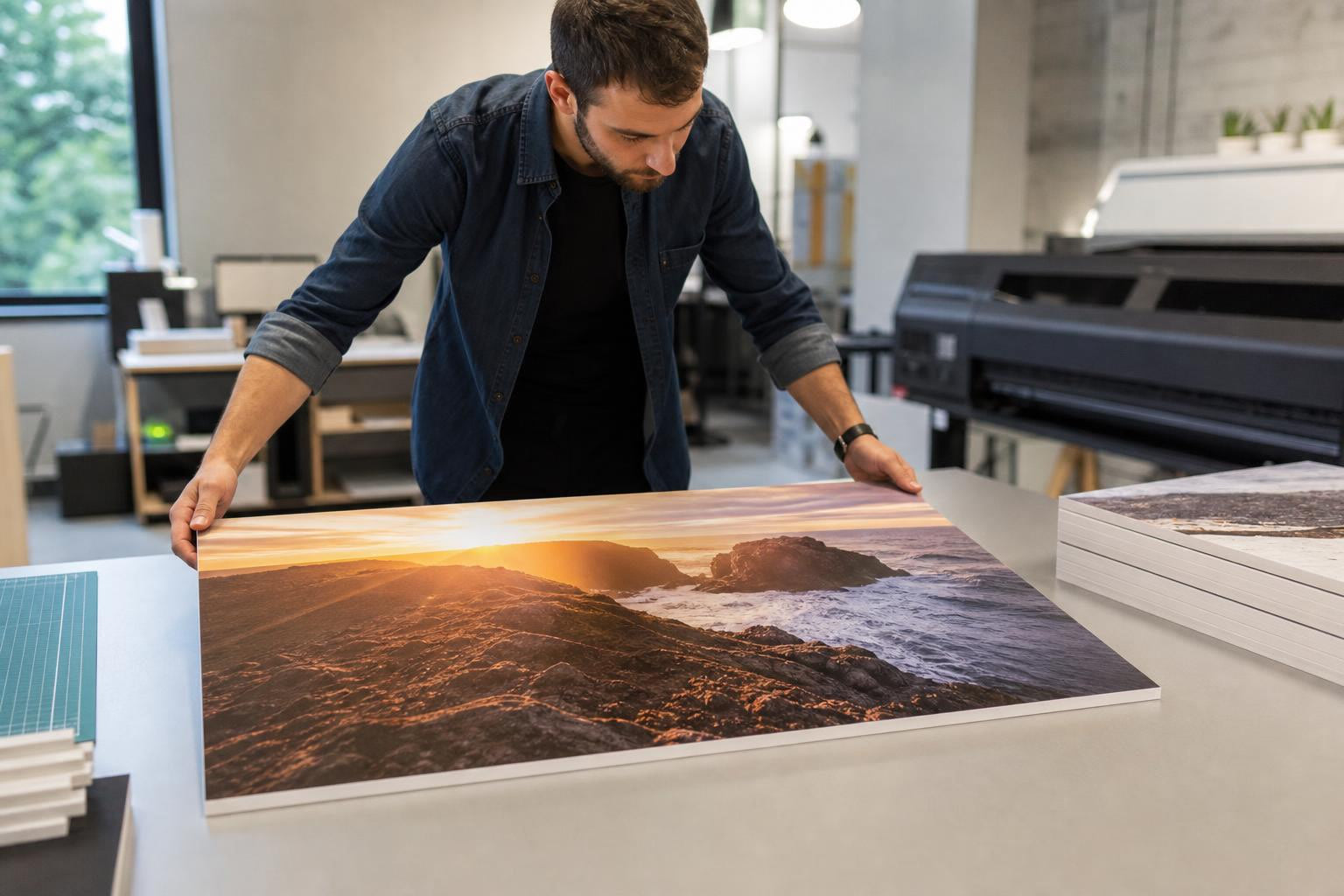
Foam board printing is the process of applying full-color graphics directly onto a rigid, lightweight panel made of polystyrene foam sandwiched between two sheets of paper. The terms “foam board” and “foam core” are used interchangeably in the printing industry, both referring to the same material.
The material itself has been around since 1961, when Monsanto introduced it under the trade name “Fome-Cor” for the graphic arts industry. Modern foam board printing uses UV-curable inkjet technology: large-format printers deposit liquid inks directly onto the board surface, and ultraviolet light instantly cures (hardens) the ink. This direct-to-substrate method produces sharp detail and vivid color without the need for separate mounting or adhesive.
Foam board comes in standard thicknesses of 1/8", 3/16", and 1/2", with the polystyrene core being 95 to 98% air. That composition is what makes the material so remarkably light.
Explore custom foam board printing to see available sizes, materials, and finishes.
The Core Benefits of Foam Board Printing
Lightweight and Easy to Transport
Because the foam core is almost entirely air, even large panels weigh very little. A standard 3/16" board weighs roughly 1.5 pounds per square foot, meaning a 24x36" display tips the scale at about 3.75 pounds. One person can carry, hang, or rearrange multiple boards without any help.
This matters in practical terms. At trade shows, you’re often setting up and tearing down alone or with minimal staff. A 4x8-foot foam board panel is genuinely manageable for a single person, something you can’t say about wood, acrylic, or metal signs of the same size.
Remarkably Cost-Effective
Foam board printing is one of the most budget-friendly options in rigid signage. Full-color direct printing typically runs $3 to $10 per square foot, depending on size, quantity, and finish. A standard 24x36" print lands in the $27 to $54 range. Compare that to acrylic or metal prints of the same size, which can easily run into the hundreds.
This price point makes foam board practical for situations where you need multiple signs (retail store rollouts, conference room sets, event signage) without blowing the budget. It also makes reprints painless when promotions change or events rotate seasonally.
Professional Print Quality
The smooth paper surface of foam board accepts UV ink beautifully. Colors come out vivid, gradients render cleanly, and fine text stays sharp. For most viewing distances (three feet and beyond), foam board prints are visually comparable to prints on far more expensive substrates.
Photographers increasingly prefer printing directly on foam board for a frameless, contemporary look. There’s no glass, no visible mounting hardware, nothing to distract from the image. The result is a clean, gallery-style presentation at a fraction of the cost.
Versatile Display Options
One of the strongest foam board printing benefits is how many ways you can actually display the finished product. This isn’t a material that forces you into a single mounting method.
You can prop boards on easels for presentations and lobbies. You can mount them on walls using foam board wall clips for a sleek, professional look. You can set them on countertops with triangle feet for point-of-sale displays. Window-facing signs work with suction cups, and ceiling-hung displays are straightforward with grommets and S-hooks.
This flexibility means a single print format can work across your entire signage ecosystem, from the front window to the checkout counter to the break room.
Double-Sided Printing
When you need a sign that reads from both directions, double-sided foam board printing is the answer. This is particularly useful for ceiling-hung signs in retail aisles, directional signage at conferences, and freestanding displays where people approach from either side.
Hanging foam board prints with grommets make it simple to suspend double-sided boards from drop ceilings or overhead structures.
Customizable Sizes and Shapes
Foam board can be printed and cut to virtually any size up to 4x8 feet (a standard full sheet). Beyond rectangular panels, the material is easy to die-cut into custom shapes: arrows, speech bubbles, product silhouettes, holiday-themed cutouts. A craft knife is all it takes for small custom jobs, and professional print shops handle complex shapes with precision routing.
This flexibility opens up creative possibilities that rigid materials like acrylic or metal simply can’t match at the same price point.
Multiple Finish and Lamination Options
The right finish can make or break a display depending on the environment. Foam board printing offers three main lamination choices, and each one serves a specific purpose.
Matte lamination eliminates glare and resists fingerprints. It’s the best choice for courtroom exhibits under harsh fluorescent lighting, conference presentations, and any space where overhead lights would cause distracting reflections. For more on this topic, read about choosing finishes for glare control.
Gloss lamination amplifies color saturation and contrast. Retail displays, photo prints, and marketing graphics pop under gloss. It also repels moisture better than unlaminated or matte options, though it does show fingerprints more readily.
Dry-erase lamination turns a foam board into a reusable sign. Grocery stores use them to update weekly specials. Meeting rooms use them for agendas. Restaurants swap out daily features without reprinting. Dry-erase foam boards combine the visual quality of a printed background with the practicality of a whiteboard.
Quick Production Turnaround
Foam board is one of the fastest rigid substrates to produce. UV-curable ink dries instantly under the curing light, so there’s no waiting period between printing and finishing. Many print shops offer turnarounds of one to three business days. Foam Board Print Shop ships orders placed by midnight the next business day, with free UPS Ground included.
Solid Indoor Durability
A foam board print isn’t disposable. With proper care, indoor displays last one to three years. UPrinting reports a lifespan of two or more years indoors, while SquareSigns puts the window at two to three years before a refresh is needed. Adding lamination extends that further by protecting the printed surface from scuffs, minor moisture, and UV exposure from ambient indoor light.
Staples rates their foam core products at a one-year indoor lifespan for unlaminated prints, which gives you a conservative baseline.
Limitations Worth Knowing
Honest coverage of foam board printing benefits requires acknowledging where the material falls short.
Outdoor use is a no-go for permanent installations. Moisture, direct sunlight, and wind will warp, discolor, or physically damage foam board. If you need outdoor signage, PVC or Sintra boards are better options.
The surface dents and creases. Foam board isn’t rugged. Rough handling during transport, stacking heavy objects on top, or bumping corners will leave marks. Careful packaging and storage matter.
Humidity causes warping. This is the single most common complaint from practitioners. A DPReview forum thread from an experienced photographer explained the physics: “The photo and the substrate likely do not handle moisture at the same rate. Trouble.” A practitioner with 20 years of mounting experience detailed on Visual Foodie that “the secret wasn’t about using more glue or heavier weights; it was about balancing tension. The paper on one side shrinks or expands as adhesive dries, pulling the foam with it.”
This is precisely why professional direct UV printing is superior to DIY mounting. When ink is cured directly onto the surface, there’s no adhesive layer creating uneven tension between the paper facings. The warping risk drops significantly.
For large panels, go thicker. The standard 3/16" thickness works well for signs up to about 24x36". Anything larger, especially if it needs to stand on its own, should use 1/2" foam core for better rigidity. This is a detail most competing articles skip, but practitioners on printing forums consistently recommend the thicker stock for panels over 24x36".
Direct UV Printing vs. Mounting: A Distinction That Matters
Most articles about foam board printing benefits gloss over this, but there are actually two different production methods, and the difference affects quality.
Direct UV printing applies ink straight onto the foam board surface using a flatbed UV printer. It’s faster, eliminates the risk of air bubbles and misalignment, and produces vibrant, durable results. This is the standard method for signage and displays.
Mounting involves printing your design on paper or vinyl first, then adhering it to the foam board with adhesive. This can deliver finer art-quality results and allows different textures, but it introduces the bubble and warping risks mentioned above.
For most commercial applications (trade shows, retail, events, presentations), direct UV printing is the better choice. Reserve mounting for specialty art reproduction where a specific paper texture is part of the aesthetic.
Foam Board vs. Other Rigid Substrates
Understanding where foam board sits in the spectrum of display materials helps you make the right call.
| Material | Cost per sq ft | Weight | Indoor Lifespan | Outdoor Use | Best For |
|---|---|---|---|---|---|
| Foam board | $3 to $10 | Ultra-light | 1 to 3 years | No | Events, presentations, retail |
| Gator board | $8 to $15 | Light | 3 to 5 years | Limited | Multi-use trade shows, galleries |
| Sintra/PVC | $10 to $20 | Moderate | Up to 10 years | Yes | Permanent signage, damp areas |
| Acrylic | $15 to $40+ | Heavy | 10+ years | Yes | Premium branding, lobbies |
Foam board wins on cost and portability. When you need something more permanent or weather-resistant, you move up the material ladder, but you pay for it. For the majority of indoor display needs, foam board hits the sweet spot.
Common Uses for Foam Board Prints
Trade Shows and Conferences
Foam board is a trade show staple for good reason. Lightweight panels are easy to pack, quick to set up, and inexpensive enough that you can update graphics for each event without agonizing over the budget. After the show, boards pack flat for storage or recycling.
Retail and Point-of-Sale Displays
Promotional signs, menu boards, seasonal displays, and product features all work well on foam board. Countertop foam board prints with built-in stands sit right at checkout, and wall-mounted panels can transform a bare retail space overnight.
Weddings and Events
Budget-conscious couples have embraced foam board for welcome signs, seating charts, photo booth props, and table numbers. Practitioners on Reddit’s r/Weddingsunder10k regularly recommend foam board printing as an affordable alternative to custom wood or acrylic event signage. The material looks polished in photos without the premium price tag.
Courtroom and Legal Presentations
Attorneys use foam board exhibits because they’re large enough to be visible from the jury box, rigid enough to stand on an easel, and matte lamination eliminates glare under courtroom lighting. Read more about courtroom exhibit preparation for specific guidance on this use case.
Education and School Projects
From science fair tri-folds to university research posters, foam board remains the go-to presentation material in academic settings. It’s affordable enough for student budgets, light enough to carry across campus, and sturdy enough to stand up through a full day of poster sessions.
Novelty and Custom Items
Beyond traditional signage, foam board is the material behind big-head cutouts for sporting events, oversized foam board checks for fundraisers and awards, and custom standees for marketing activations. These specialty products take full advantage of foam board’s easy-to-cut nature and vivid print quality.
How to Get the Most from Your Foam Board Prints
A few practical tips will extend the life and appearance of your foam board displays.
Prepare files at 300 DPI minimum. This ensures sharp output at full size. For guidance on file preparation, check out recommended DPI and file setup for large foam board prints.
Match lamination to environment. Matte for glare-sensitive settings (courtrooms, conference rooms). Gloss for visual impact (retail, photo displays). Dry-erase for signs that need regular updates (restaurants, meeting rooms).
Choose the right thickness. Use 3/16" for standard signs up to 24x36". Step up to 1/2" for larger panels or anything that needs to stand without support.
Store boards flat. Keep them in a cool, dry space away from direct sunlight. Leaning boards against a wall invites warping over time.
Add hardware at order time. Grommets, drilled holes, or rounded corners are easier and cleaner when done during production rather than after the fact.
Order with margin for error. If you’re preparing for a big event, having production done early gives you a buffer for shipping and any last-minute changes.
Start your order at Foam Board Print Shop or contact the team for help choosing the right options.
Frequently Asked Questions
What are the main benefits of foam board printing?
The primary foam board printing benefits are lightweight portability, low cost ($3 to $10 per square foot), vivid print quality, and versatile display options. Foam board can be wall-mounted, hung from ceilings, placed on easels or countertops, and cut into custom shapes. It’s the most affordable rigid display material available.
How long do foam board prints last?
With proper indoor care, foam board prints last one to three years. Laminated prints last longer because the protective layer guards against scuffs, minor moisture, and ambient UV exposure. Unlaminated prints in well-lit areas may begin to fade after six to twelve months.
Can foam board be used outdoors?
No, not for permanent installations. Moisture, direct sunlight, and wind will warp or damage foam board. For short outdoor events (a few hours on a calm day), foam board can work in a pinch, but PVC or Sintra boards are better choices for any extended outdoor use.
What is the difference between direct UV printing and mounting on foam board?
Direct UV printing applies ink straight to the foam board surface using ultraviolet-cured inkjet technology. Mounting involves printing on paper or vinyl first and then adhering it to the board. Direct printing is faster, eliminates air bubbles, and reduces warping risk. Mounting can achieve specific paper textures for fine art applications.
What thickness of foam board should I choose?
For most signs and displays up to 24x36", 3/16" foam core is the standard and works well. For larger panels or displays that need to stand unsupported, 1/2" provides significantly better rigidity. Some print shops also offer 1/8" for lighter-duty applications like backing for framed prints.
Is foam board printing good for trade shows?
It’s one of the most popular materials for trade shows precisely because of foam board printing benefits like portability and cost. Large displays are light enough for one person to carry, affordable enough to update for each show, and professional enough to represent your brand effectively.
What file resolution do I need for foam board printing?
A minimum of 300 DPI at the final print size produces the best results. Lower resolutions (150 to 200 DPI) can work for very large prints viewed from a distance, but 300 DPI is the safe standard for sharp text and detailed images.
Can foam board prints be displayed double-sided?
Yes. Double-sided printing is available and works especially well for ceiling-hung signs in retail aisles, directional conference signage, and freestanding displays where viewers approach from both directions. Grommets or clips make hanging simple.


